
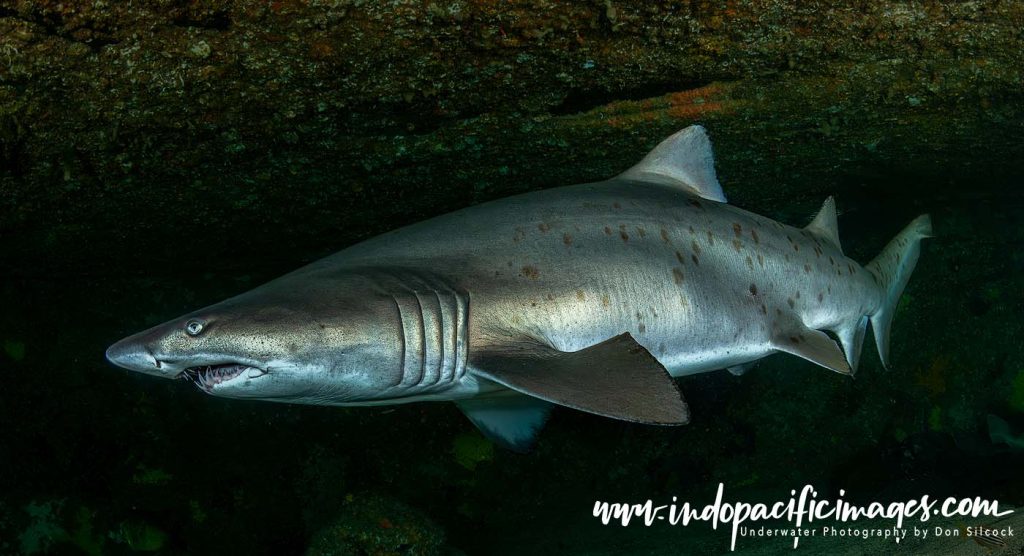
Photographing Grey Nurse Sharks… Any underwater encounter with any large creature is an exciting experience. But the size and physical presence of Australian Grey Nurse sharks makes such encounters pretty memorable!
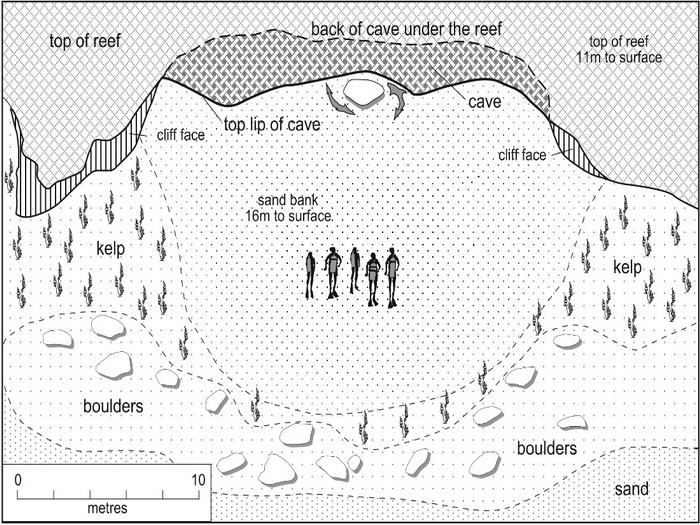
Most of my experience with Grey Nurse sharks in Australia has been in the cave at Magic Point near Maroubra in Sydney. Typically you are not allowed to enter the cave because of the potential impact on the sharks. However in the process of getting the images for this site and my articles on the Grey Nurse (after being extensively coached on what and what not to do) I was fortunate to be allowed to spend a reasonable amount of time in there.
The cave is a special place… It’s basically where the sharks “hang out” during the day. Grey Nurse hunt and feed at night, when we have no real way of observing them when they are most active. Instead we encounter them during the day, when they like to hang out in gutters, caves and overhangs to shelter from prevailing currents and potential predators.
Observed this way they seem completely docile. Almost kind of dumb as they patrol slowly round and round in an apparently aimless fashion. But the reality is they are resting and have slowed their metabolism right down to conserve energy. Basically they are almost sleep-walking – or should that be sleep-swimming?
That slow and deliberate swimming makes Grey Nurse sharks ideal photographic subjects as they often return repeatedly along the same paths. Which, from the photographer’s perspective, allows time to pre-visualise possible compositions, adjust strobe position and wait for clean backgrounds and eye contact
Their large size, often exceeding 3m, also provides excellent scale when framed against reef structure or divers.
Before You Press the Shutter…
Successful photography with Grey Nurse Sharks begins long before you lift a camera… These sharks are naturally quite tolerant of divers, but they are not indifferent to disturbance. Rapid finning, sudden movements, or aggressive positioning can cause sharks to alter their swim paths or leave the area entirely. Thus ending the photographic opportunity for everyone!
Key behavioural cues to watch for are smooth, steady swimming which indicates the shark is relaxed, along with repeated circling which suggests comfort with the presence of divers.
Alternatively, abrupt direction changes or increased speed signal stress as does changes in breathing rate. Which are indicated by gaping of their mouths and the speed at which they flick their tails. The two are strongly linked because an unstressed Grey Nurse swims in a relaxed manner at a rate that provides enough oxygenated water through its mouth and over its gills.
A stressed shark on the other hand has to move faster to increase the flow of water through the gills and tends to “gape” its mouth to boost the overall oxygenation effect.
Photographing Grey Nurse Sharks at Magic Point
Patience and preparation are probably the two most important factors associated with taking good Grey Nurse images at Magic Point.
It took me several dives there before I got some publishable photographs.
Visibility at Magic Point is rarely very good in my experience and a “good day” is around 15m, but often it is less than 10m.
As with all underwater photography, Rule #1 is get close and Rule #2 is get closer… Which at Magic Point is not always possible because of the rules about not going in the cave.
This is where the patience comes in… You need to position yourself along the wall at either end of the cave and assume a non-threatening posture.
Settle your breathing rate down so that you are not making too much noise. And then wait for the sharks to come to you – which they usually will.
Then you need to be prepared with your strobes extended out and back from the camera to minimize backscatter. A shutter speed of at least 1/250 of a second – because the sharks are moving objects. Your f stop should be open enough to allow adequate light for the background exposure. And finally the power of your strobes adjusted to light the shark.
Composure should place the shark in its environment. The focus point should be the eye, as we are always drawn to the eye of any creature. But particularly so with large sharks… so the eye needs to be tack sharp!
Photographing Grey Nurse Sharks – NSW
Magic Point in Sydney – One of Australia’s most reliable Grey Nurse aggregation sites
Fish Rock at South West Rocks – Cave systems and swim-throughs create dramatic lighting opportunities
Solitary Islands Marine Park – Seasonal aggregations in clear water
Photographing Grey Nurse Sharks – Queensland
Stradbroke Island, near Brisbane – Flat Rock. known for close passes and mid-water encounters
Wolf Rock near Rainbow Beach – A critical aggregation and breeding site