

Understanding the Lembeh Strait – The Heart of the Coral Triangle
Understanding the Lembeh Strait… Lembeh’s extraordinary concentration of critters is the result of several overlapping geological, oceanographic, and ecological factors.
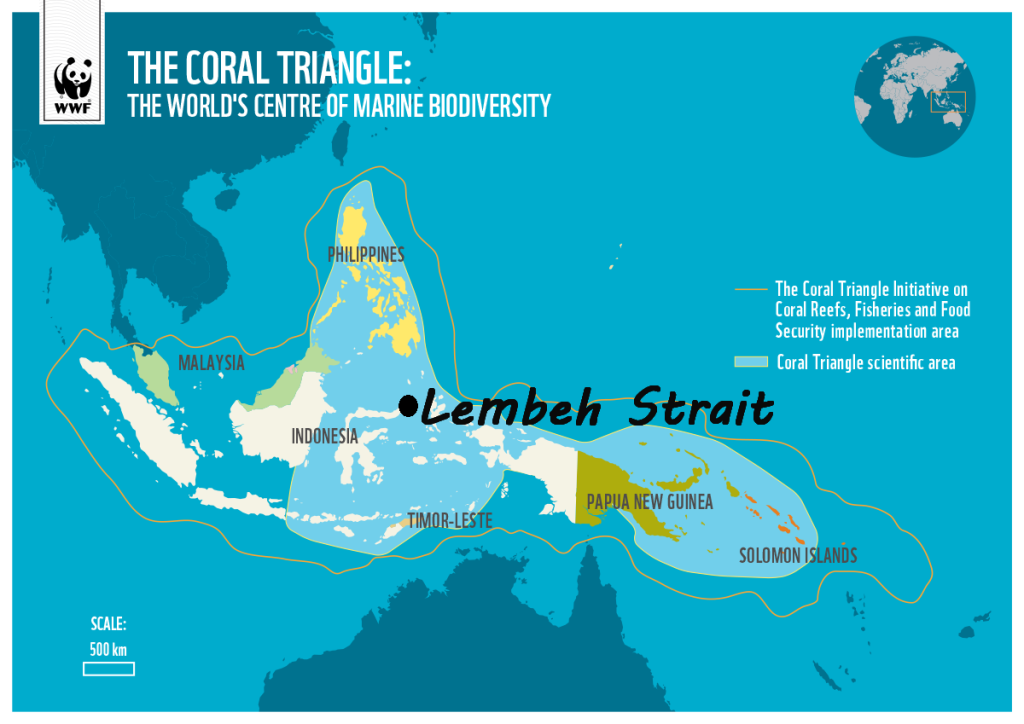
First of all is location, directly in the path of the Indonesian Throughflow, the vast oceanic current that connects the Pacific and Indian Oceans and fuels the biodiversity of the Coral Triangle — the global epicentre of marine life extending from Indonesia to the Philippines in the north and the Solomon Islands to the east.
This unique position makes Lembeh both a crossroads and a nursery. Larvae drifting from nearby reefs such as Bangka and Bunaken can find refuge in the Strait’s calm waters, settling into one of the most biologically diverse channels in the world.
Volcanic Origins and Unique Underwater Topography

The Strait’s black-sand seafloor is the product of nearby volcanic activity, particularly from Mount Tangkoko.
This fine, dark substrate provides both camouflage and contrast — a perfect hunting ground for cryptic species that rely on mimicry and stealth.
The narrow channel between the mainland and Lembeh Island creates a sheltered marine corridor with minimal wave action.
These calm, predictable conditions enable delicate organisms to thrive without being disturbed by strong currents or sudden environmental changes.
Nutrient-Rich Waters and a Self-Sustaining Ecosystem
Along the North Sulawesi coast, deep oceanic upwellings bring cold, nutrient-rich waters toward the surface. These nutrients fuel plankton blooms that support a thriving food web – from detritus-feeding nudibranchs and shrimps to the predators that hunt them.
Thanks to this constant nutrient flow, the Lembeh Strait sustains remarkable biodiversity despite lacking extensive coral reefs — a rare and fascinating ecological phenomenon.
Understanding the Lembeh Strait – A Mosaic of Microhabitats
Although often described simply as “muck diving”, the Lembeh Strait actually contains a complex mosaic of habitats: sandy slopes, volcanic rubble, seagrass beds, sponge gardens, and even man-made structures such as shipwrecks and discarded coconut shells.
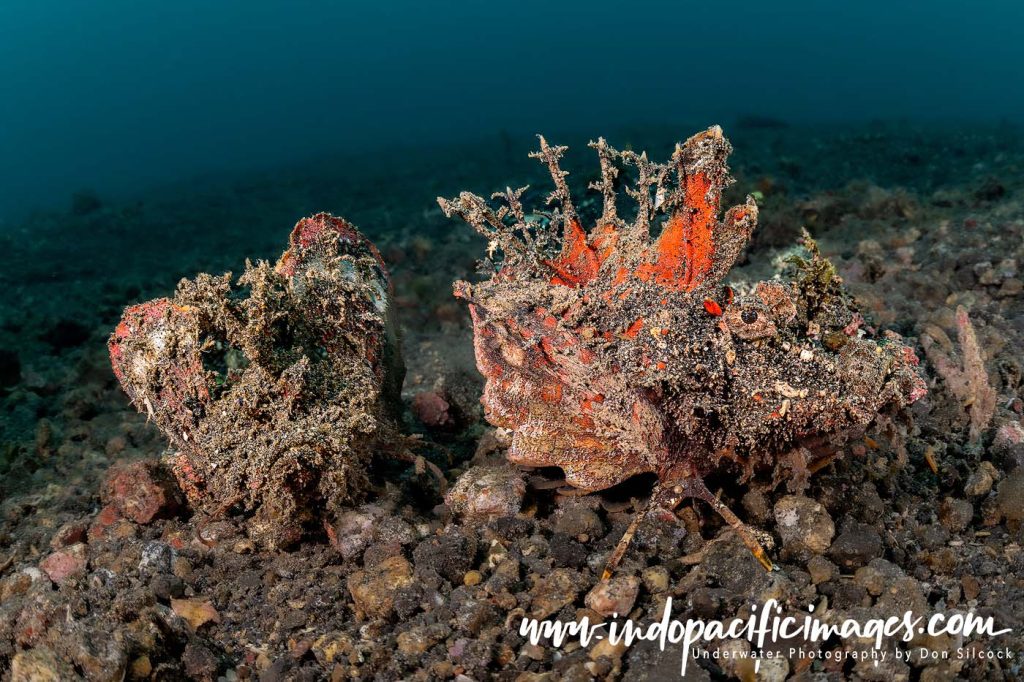
Each microhabitat supports its own specialised community of life. With juvenile fish and pipefish hide among the seagrass, ambush predators like frogfish and scorpionfish lurking in rubble fields, while octopuses and crustaceans occupy bottles, tyres, and other debris.
This intricate patchwork allows an astonishing variety of species to coexist within a remarkably compact area.
Stable Conditions for Evolutionary Adaptation
Because the Lembeh Strait is so sheltered from open ocean swells, it experiences stable temperatures and mild currents year-round. That stability allows delicate and slow-reproducing species like flamboyant cuttlefish and rhinopias to thrive without being swept away or physically stressed.
Over time, these conditions have encouraged evolutionary specialisation, resulting in species that exhibit remarkable camouflage, mimicry, and reproductive strategies — the hallmarks of Lembeh’s biodiversity.
Human Influence and Conservation Success
Unlike many other coastal regions in Indonesia, the Lembeh Strait ecosystem has benefited from early and sustained sustainable dive tourism. Dive resorts, NGOs, and local authorities have worked together to try and preserve the area’s habitats while promoting awareness of its ecological importance.
This collaboration has helped discourage destructive fishing, reduce pollution, and foster a community deeply invested in protecting the Strait’s delicate marine life. As a result, Lembeh remains one of Indonesia’s best-preserved dive destinations.
Understanding the Lembeh Strait – In Summary…
In essence, understanding the Lembeh Strait means recognising how geology, geography, oceanography, and ecology intertwine. Volcanic origins created the black sand. The Indonesian Throughflow brought nutrients and larvae. Stable conditions and varied habitats encouraged adaptation and survival.
Together, these natural forces produced one of the richest concentrations of marine life on the planet — a haven for underwater photographers, scientists, and divers alike. For anyone passionate about marine biodiversity, understanding the Lembeh Strait offers a glimpse into how nature, over millennia, transformed a narrow channel into Indonesia’s critter capital.