
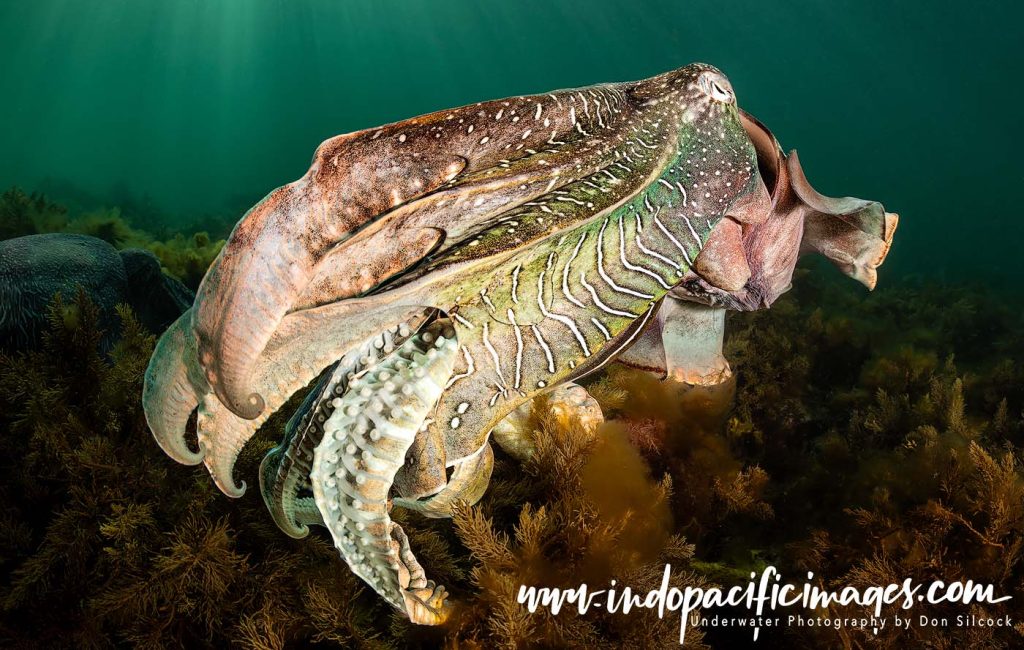
The Giant Australian Cuttlefish (Sepia apama) is a creature of biological superlatives. As the largest cuttlefish species on the planet, it is a master of camouflage, a cunning strategist, and a marvel of cephalopod evolution. Endemic to the temperate coastal waters of southern Australia and ranging from southern Queensland around the southern coast to Western Australia.
This species represents one of the most complex life histories in the marine world.
Unique Biological Characteristics
Probably the single most striking feature of Sepia apama is its sheer size. Adult males can reach a mantle length of up to 50cm and a total length of 1m, with its outstretched tentacles. Fully grown they weigh in at around 10kg.
Like all cephalopods, they possess a sophisticated anatomy as their “Head-Foot” plan shows:
- Eight arms and two retractable feeding tentacles that can shoot out of their sockets with lightning speed to snatch fish and crustaceans.
- Three Hearts and Blue Blood: To support their active metabolism, they have three hearts that pump blue, copper-based blood (hemocyanin) through their bodies.
- The Cuttlebone: Cuttlefish have a porous internal shell called a cuttlebone. By regulating the ratio of gas to liquid within these microscopic chambers, they can maintain perfect neutral buoyancy at various depths.
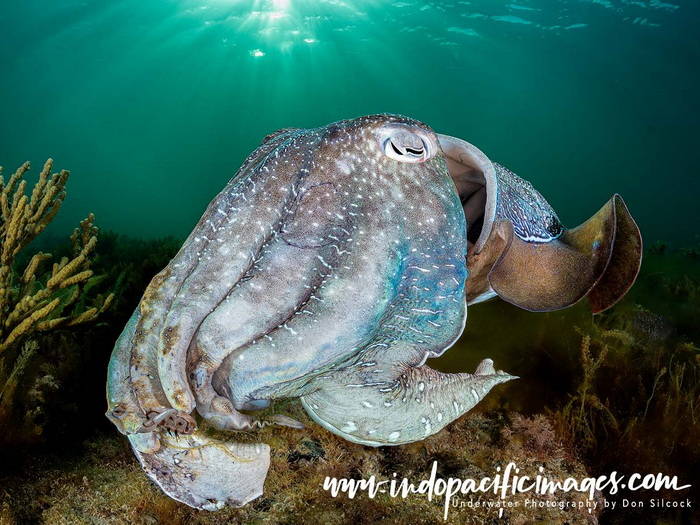
- Panoramic Vision: Their unique “W-shaped” pupils are thought to allow them to see both in front and behind simultaneously. While they are colorblind, they are highly sensitive to the polarization of light, which helps them detect transparent prey and navigate.
- “Electric” Skin: When a cuttlefish is “displaying” it’s a truly awesome sight to behold and the enabler is its skin, which is essentially a living, high-resolution screen. Using millions of neurally controlled cells called chromatophores (pigment sacs), iridophores (reflective cells), and leucophores (white base cells), they can change their color and pattern in milliseconds. They also use papillae—small bundles of muscles—to alter the texture of their skin to mimic jagged rocks, sand, or kelp.
Living Fast and Dying Young
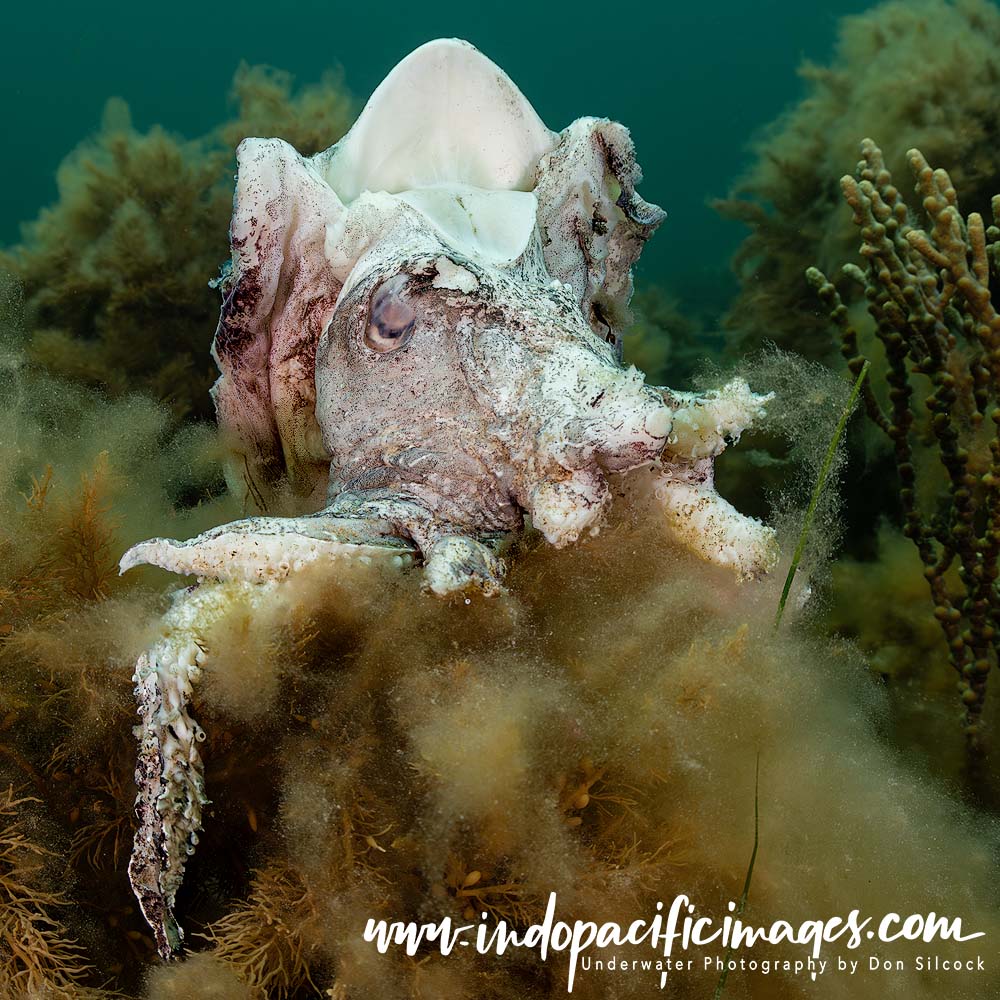
The life of a Giant Australian Cuttlefish is a classic example of “live fast, die young.” They typically live for only 12 to 24 months. Their entire existence is a race to grow large enough to compete in a single, terminal reproductive event.
Growth Phase
Hatchlings emerge as miniature versions of adults, roughly 12 mm long. They are immediately independent and begin hunting tiny shrimp and crustaceans. Interestingly, Sepia apama follows two distinct growth tracks:
The Fast Track: Some individuals grow rapidly and reach sexual maturity within their first year.
The Slow Track: Others grow more slowly and delay breeding until their second year, allowing them to reach much larger sizes before attempting to mate.
General Breeding Patterns
Outside of the massive aggregations often cited in specific South Australian regions, Sepia apama typically breeds in pairs or small, loose groups throughout its range. The breeding season occurs during the southern winter (May to August).
Mating Strategies: Brawn vs. Brain…
Mating is a high-stakes competition where males vastly outnumber females by as many as 11:1. This has led to the evolution of fascinating behavioral strategies:
The Bull Males: Large, dominant males use their size to defend “territories” around rocky crevices. They use vibrant, pulsing “zebra stripe” patterns to intimidate rivals and guard a chosen female.
The “Sneaker” Males: Small males that cannot compete physically use deception. They retract their “male” banner-like webs, change their skin pattern to mimic the mottled appearance of a female, and “sneak” past the dominant male to mate with the female while the “bull” is busy fighting off other large rivals.
Fertilization and Egg Laying
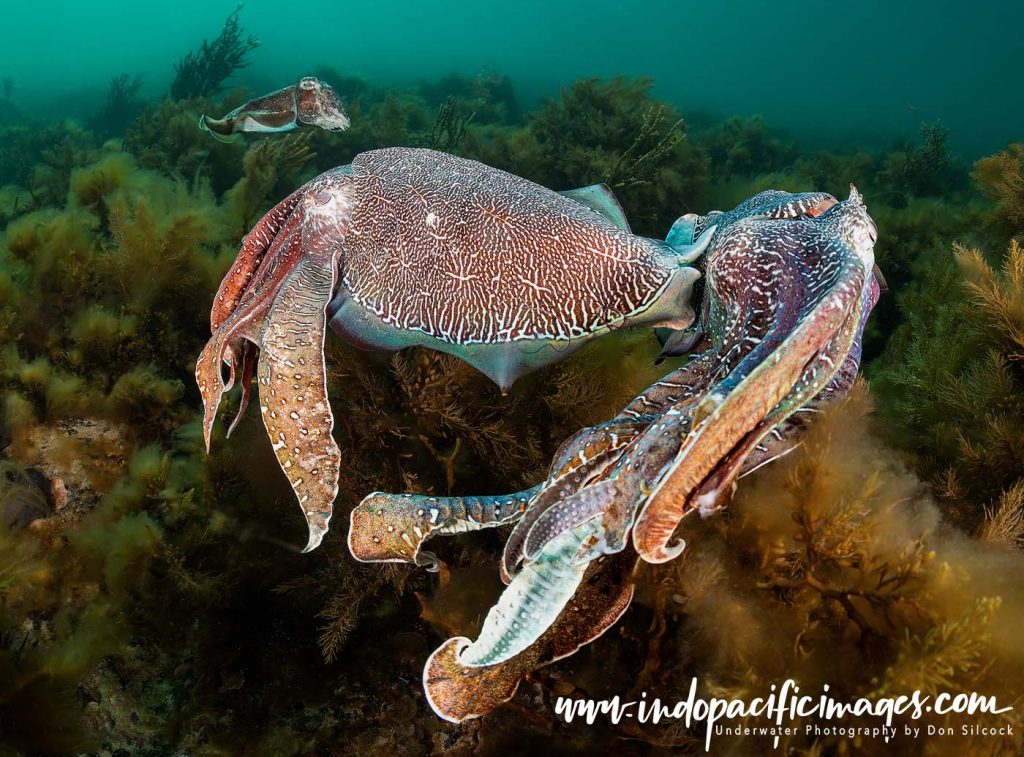
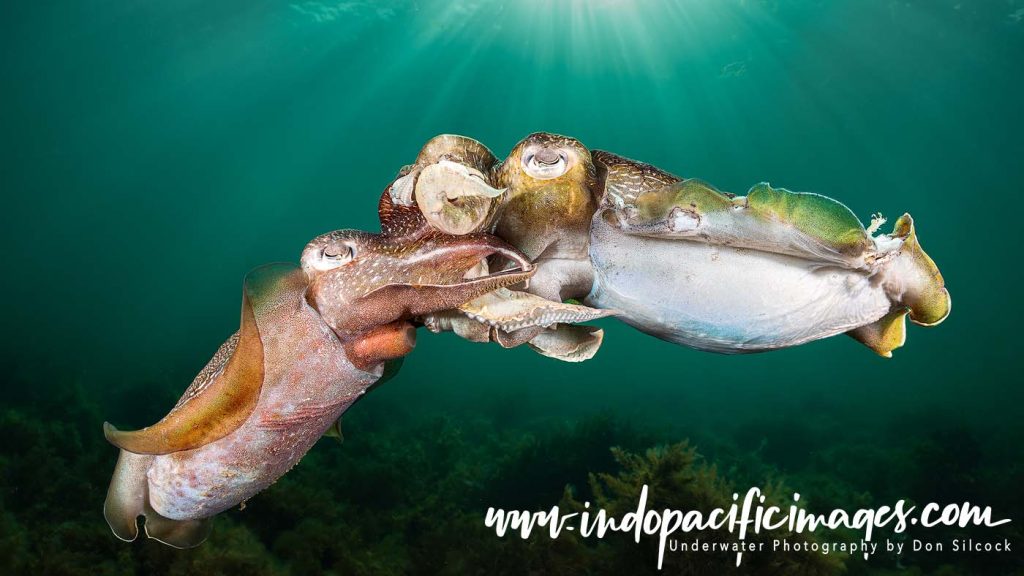
Giant Australian Cuttlefish mating in a head-to-head embrace. The male uses a specialized arm, the hectocotylus, to transfer a sperm packet (spermatophore) into a pouch near the female’s mouth
The female then retreats to a rocky crevice. She produces between 100 and 300 lemon-shaped, leathery white eggs. As she lays each egg, she passes it over the sperm packet to fertilize it before carefully attaching it to the underside of a rock ledge.
Senescence
As a semelparous species, the giant cuttlefish dies shortly after its single breeding season. Having exhausted their energy reserves on displays, fighting, and egg-laying – and often having ceased feeding entirely during the peak of the season – the adults undergo a rapid physical decline (senescence) and perish. Their white cuttlebones often wash up on beaches in late winter, serving as a skeletal reminder of the cycle’s end.