
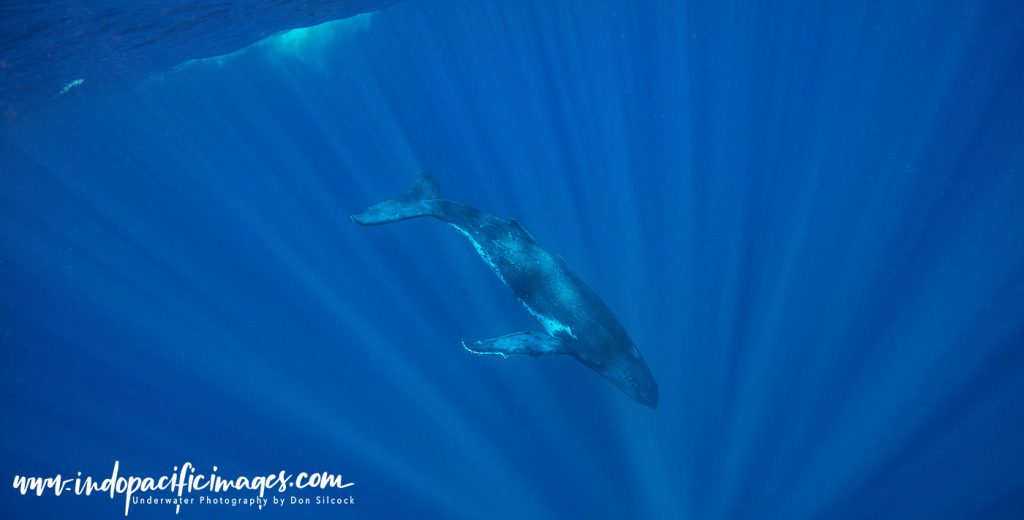
Humpback whale singer encounters in Tonga are truly extraordinary interactions. Singing whales suspend themselves motionless in the water column in an almost zen-like state, seemingly oblivious to everything around them.
There is something both strange and slightly eerie about descending into deep blue water to face such a vast creature hanging motionless in the open ocean. Watching a humpback whale suspended in space feels intensely private. I could not help feeling a little like a “peeping Tom,” quietly observing something deeply personal that I was never meant to witness.
What Is a Humpback Whale Singer?
A humpback whale singer is almost always an adult male producing a structured, repeating song during the breeding season. These songs can last 10–20 minutes and may be repeated for hours at a time. Each population of humpback whales shares a common song that gradually evolves over the course of the season.
Scientists believe singing plays an important role in mating behaviour — either to attract females or to signal dominance to rival males. In Tonga’s warm breeding waters, singers are often encountered resting vertically in the water column while vocalising.
For swimmers, this behaviour creates a rare opportunity to observe a relatively stationary humpback whale singer, allowing for calm, respectful, and carefully controlled interactions.

Humpback Whale Singer Encounters – The Songs…
Humpback whales do not have vocal cords, so they cannot “sing” in the way land mammals do. Instead, male humpbacks generate complex songs by circulating air through specialised tubes and chambers within their respiratory system.
A typical humpback whale song lasts between 10 and 30 minutes and may be repeated continuously for hours.
Scientific analysis shows these songs are remarkably complex, ranging from high-frequency squeals to deep, resonant low-frequency rumbles.
Perhaps most astonishing is that all whales in the Tongan Tribe share essentially the same song during a season, yet that song evolves from year to year. How these changes spread through the population is still not fully understood.
Research such as a paper published in PLOS One explores possible mechanisms, highlighting how much there is still to learn about these extraordinary animals.
Heard underwater, the sound waves produced by a singing humpback resonate through your entire body. Approaching a performing male can be an intense and slightly intimidating experience.
Singers are often positioned relatively close to the surface, suspended motionless in the water column. This makes it possible to duck-dive for a closer look without disturbing the whale or breaking its calm, almost meditative state.
Even so, being in close proximity to such a vast creature while it performs is a profoundly eerie and unforgettable sensation.

Back To: Humpback Encounters Main Menu