
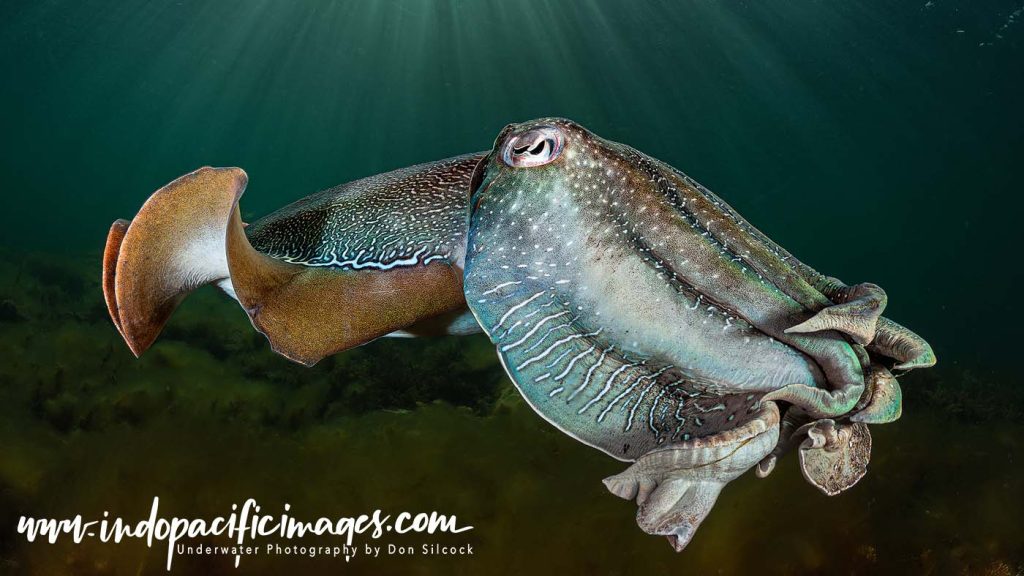
Photographing Giant Australian Cuttlefish… The annual aggregation in Whyalla is one of the world’s most accessible marine spectacles. But, because the water is shallow and the animals are bold, the challenge isn’t finding them – it’s managing the cold and capturing their incredible light displays effectively.
Essential Gear & Technical Setup
Camera
As the old saying goes… the best camera you have is the one you have with you. So it is with your underwater photography equipment and if that is a Go Pro or perhaps an Olympus TG7, then go with it and do the best you can. Under no circumstances would I recommend getting a brand new set-up for a trip to Whyalla as the challenges of getting in and out of the water there are not to be taken lightly.
Similarly, trying to learn how to use a new camera in the cold winter waters of Whyalla would also be challenging. But as a general indicator of what is required equipment wise, all the images on this page were taken with a Nikon D500.
These days I am using a Nikon Z8 in a SEACAM housing plus SEACAM 160D strobes which is simply the very best combination of underwater photography equipment I have ever used. But that said, I am very happy with the recently reprocessed D500 images I did for this page.
The moral of the story is that a ten-year old DSLR properly utilised is probably better than a new camera like the Z8 that is poorly utilised.
Lenses
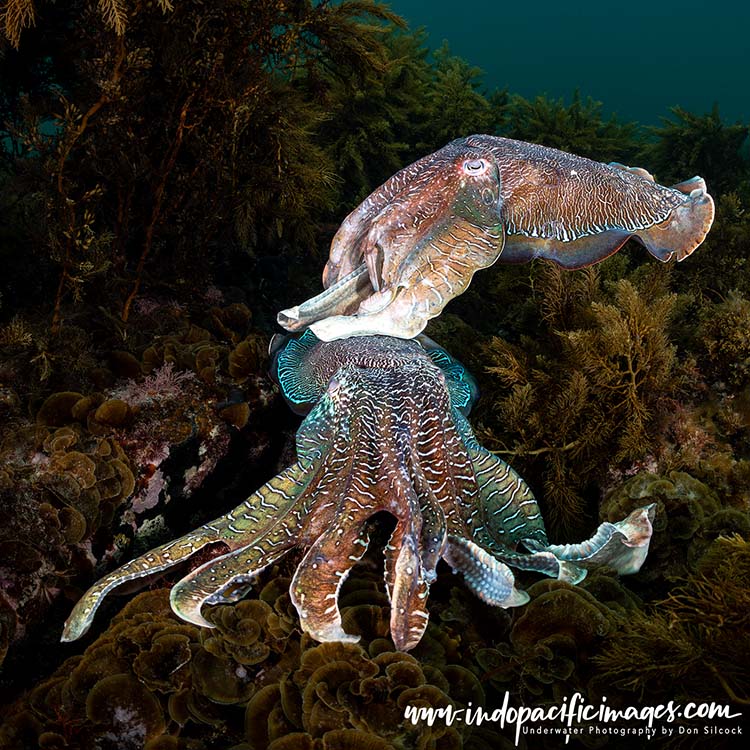
The bull male Giant Cuttlefish are by far the most photogenic element of the amazing spectacle that is the Whyalla annual mating aggregation.
They are quite large creatures which are generally fairly reserved, but at Whyalla they are often so laser-focused on their place in the mating process, it is quite easy to get very close to them.
Which dictates your choice of optics…
A wide-angle zoom such as a 16-35mm is a good choice, but close focus capability is essential!
Alternatively fisheye lenses can work well too, but I am always wary about the distortion they can produce when photographing creatures.
The images on this page were taken with the Nikon 8-15mm fish-eye zoom, which because of the DX/APSC sensor on the D500 becomes a 12-22mm.
However vignetting results in an effective range of 14-22mm and minimal distortion.
The 8-15mm is a great lens that is very sharp, focuses super close and I found it excellent at Whyalla!
The combination of wide-angle perspective and close focus allows you to get really close, fill the fame and reduce the “water column” between you and the cuttlefish, which significantly improves color and clarity.
The “Cold” Barrier
The water temperature during the Whyalla aggregation is roughly 12°C–15°C. To stay focused on your framing rather than your shivering, a drysuit or a high-quality 7mm semi-dry wetsuit with a hood and gloves is essential.
Personally I use a membrane dry suit with a quality undergarment and… a heated vest.
Minimising Backscatter
Backscatter occurs when your strobes illuminate particles (sediment, plankton, or bubbles) floating between your lens and the subject, resulting in white “snow” particles on your image. In the shallow, surge-prone waters of Whyalla, backscatter can be a major issue!
To avoid backscatter, you must ensure the light from your strobes does not hit the water directly in front of your lens. Use long(ish) strobe arms between 8–12 inches long, arranged so that your strobes are positioned just behind the handles of your housing and so behind the plane of your camera sensor.
The closer you are to your subject, the closer the strobes need to be towards the handles, and vice-versa.
Camera Settings
Personally I like to have plenty of depth of field when photographing Giant Australian Cuttlefish Settings so my go-to f-stop on a DX/APSC camera would be f11 and f13 on a full-frame camera. Then, because the cuttlefish sometimes move very quickly I generally use a shutter speed of around 1/200.
Then, with the camera in manual (M) mode and set to centre-weighted exposure, I adjust the ISO to get the background exposure I am looking for in the image.
Before I switched to the SEACAM 160D strobes I always used manual exposure on my stobes and adjusted the strobe power to get the right exposure. But I have found that TTL on the 160D strobes works superbly and I now use that 90% of the time.
Photographing Giant Australian Cuttlefish – The Physical Stuff…
Entry and Exit
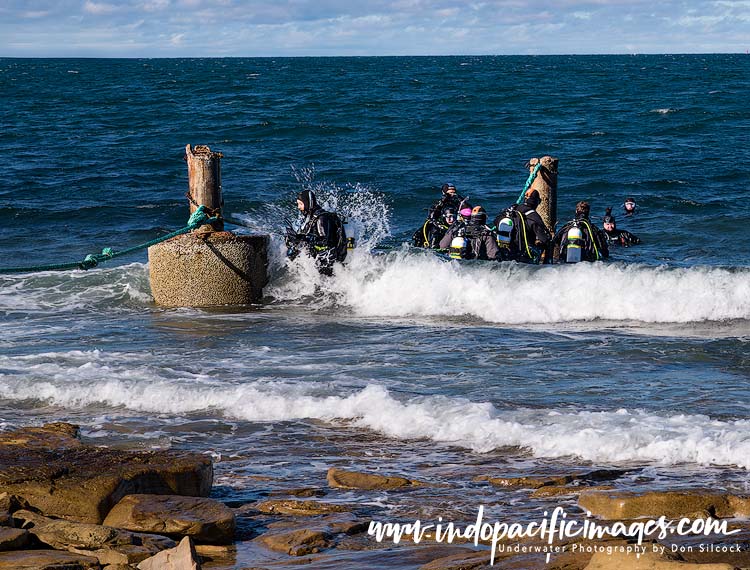
Probably the hardest part about getting good images at the Whyalla aggregation is actually getting in and out of the water because of the rocky terrain.
A lot has been done over the years to improve the access, but on a rough day it can be difficult and great care is required with your photographic equipment.
Buoyancy Control
Perhaps one of the most important elements of good underwater photography is the ability to maintain neutral buoyancy.
That is particularly so in the shallow and sometimes surgy waters at Whyalla, so it is really important to master your buoyancy control.
Patience over Pursuit
Do not chase the animals. If you remain still, their natural curiosity will often lead them to swim directly toward your camera dome.