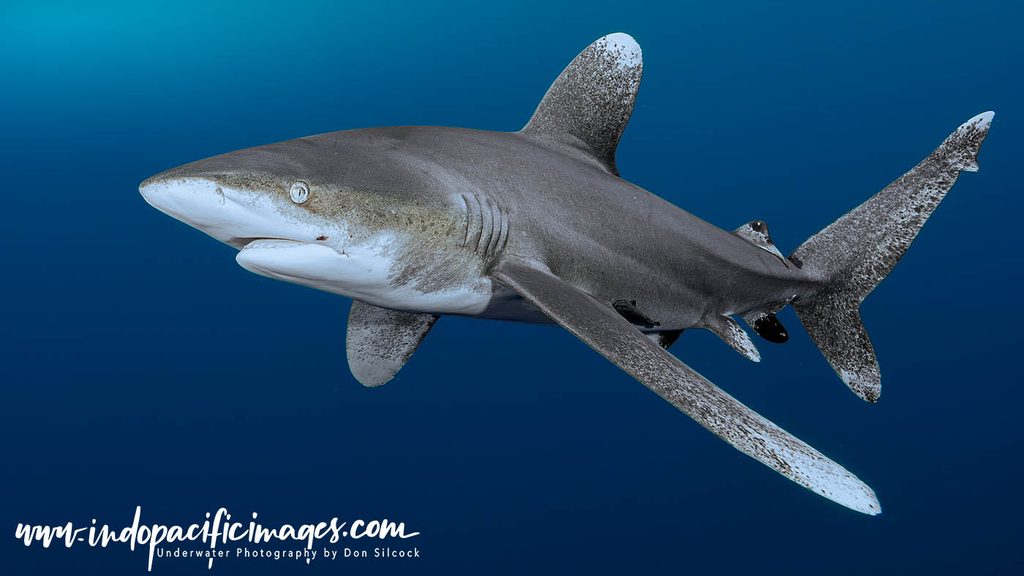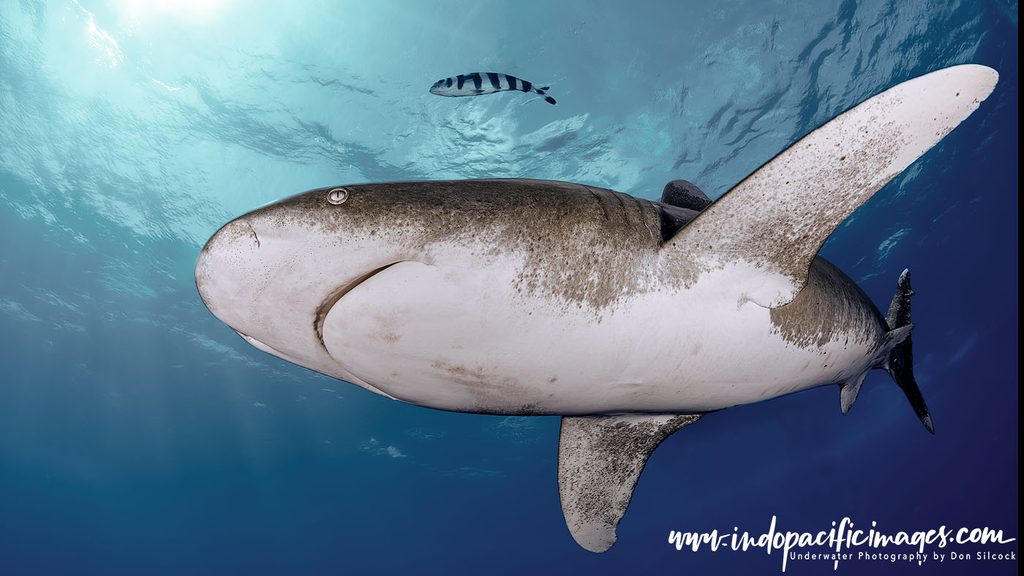
Oceanic Whitetip Sharks… It seems almost unbelievable that as recently as the mid-1960s, the Oceanic Whitetip Shark (Carcharhinus longimanus) was widely considered to be one of the most abundant large animals in the world’s oceans.
Today, it is a very different story.
Oceanic whitetips have suffered enormous population declines as a result of commercial fishing, particularly pelagic longlining and the demand for their large, distinctive fins. They are now listed as Vulnerable globally and as Critically Endangered in the north and central western Atlantic.
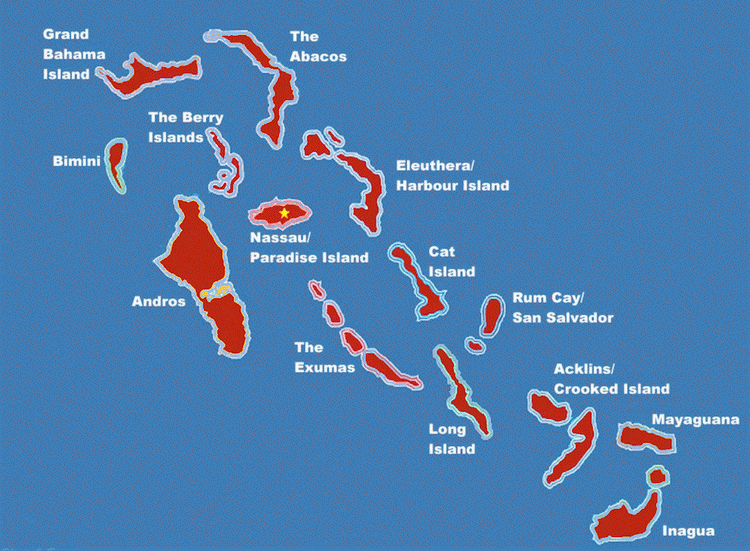
Which makes the waters around Cat Island in the Bahamas all the more remarkable.
Here, for a limited period each year, a small population of these magnificent open-ocean sharks gathers in the deep blue water off the island’s southern and eastern coast.
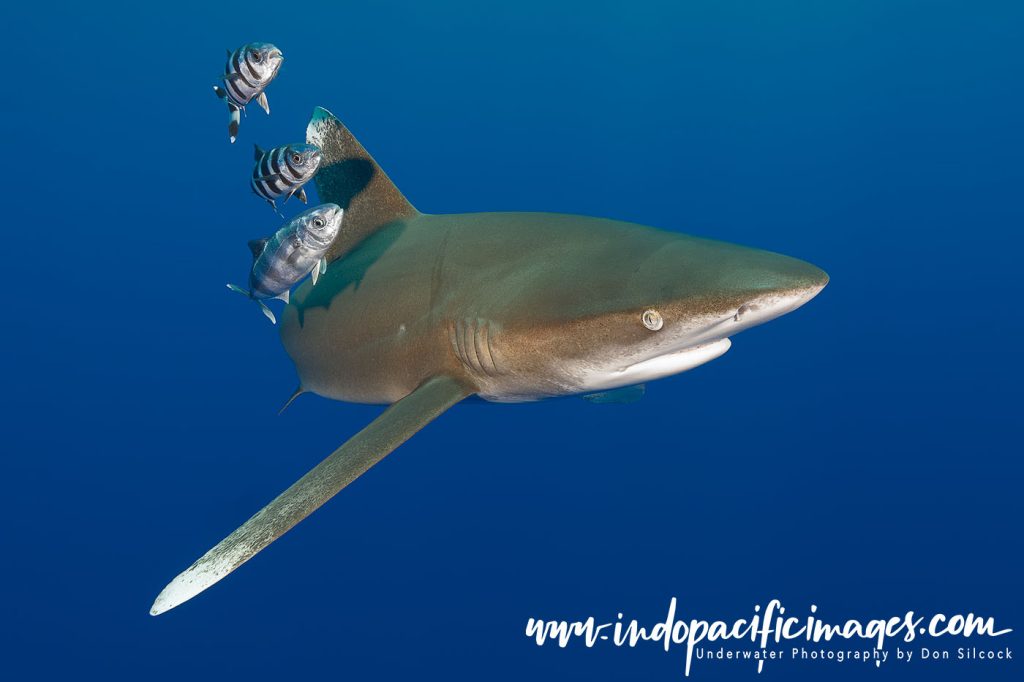
And rather than being fleeting encounters with distant individuals, the sharks can be extraordinarily close, inquisitive and persistent. For an underwater photographer, it is a remarkable experience.
Cat Island
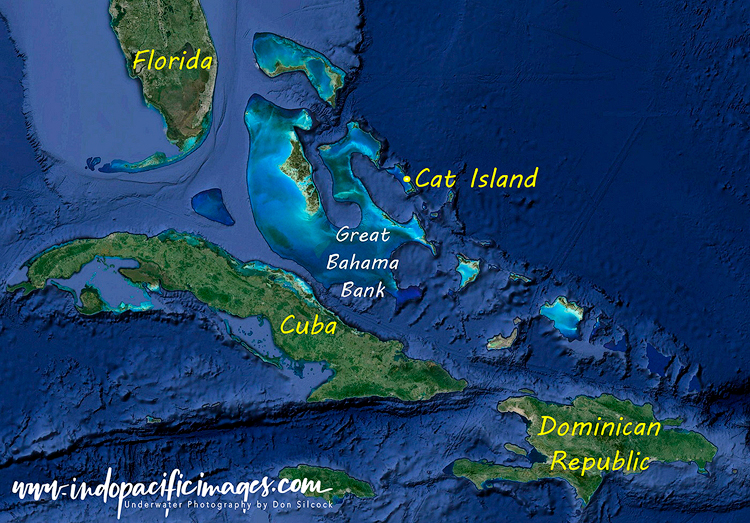
Cat Island is a long, relatively narrow island located in the central Bahamas, on the eastern edge of the Great Bahama Bank. Its eastern and southern shores sit directly alongside the deep blue waters of the western Atlantic Ocean. While the powerful Antilles Current sweeps northwards past the island.
It is an ideal location for large pelagic fish such as tuna and marlin. Which is precisely why fishermen have traditionally worked these waters. And… it also happens to be an ideal environment for oceanic whitetips.
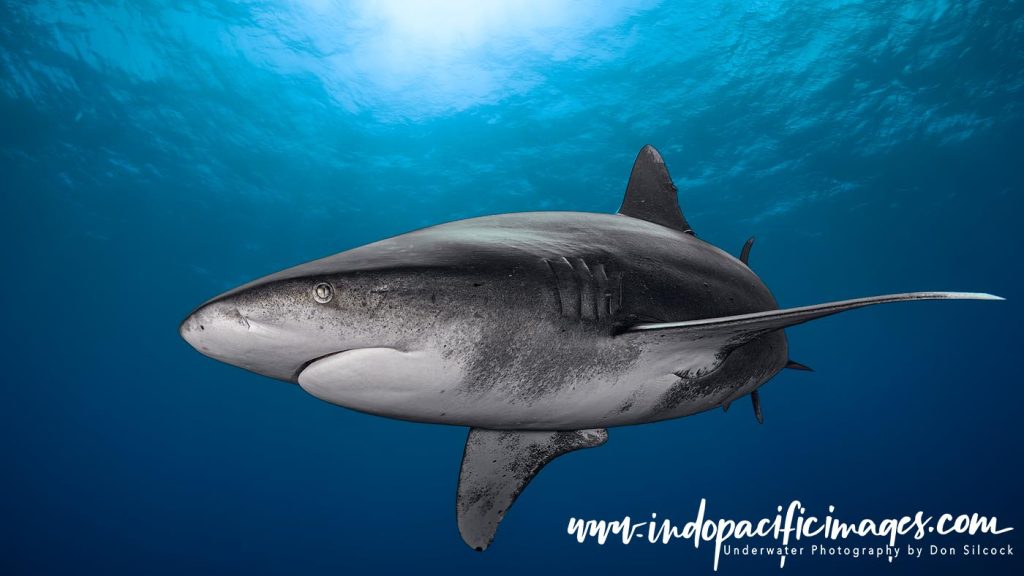
Unlike many shark, Oceanic Whitetips are true pelagic animals. They spend much of their lives in the open ocean. Generally in the upper part of the water column, travelling long distances in search of food.
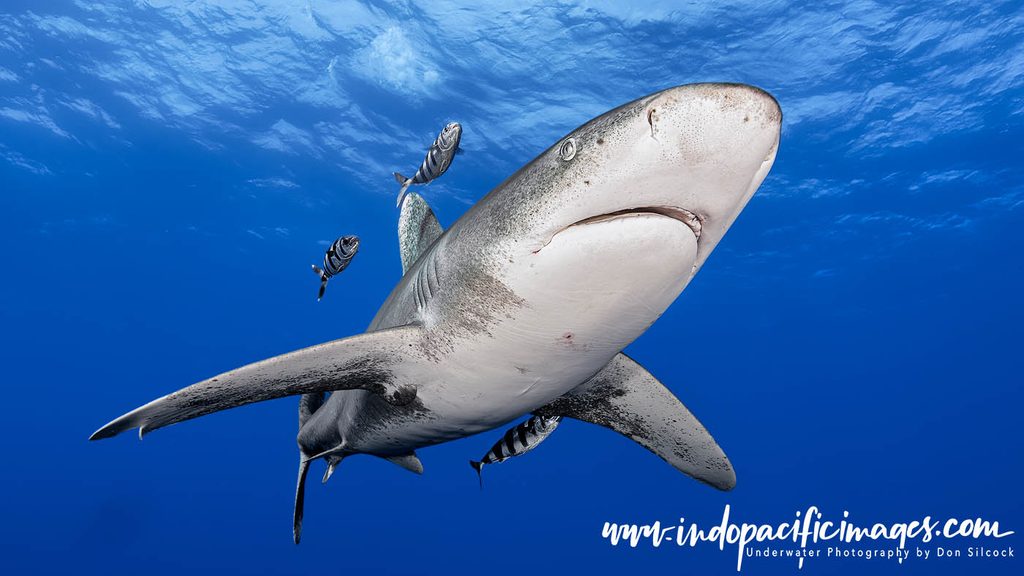
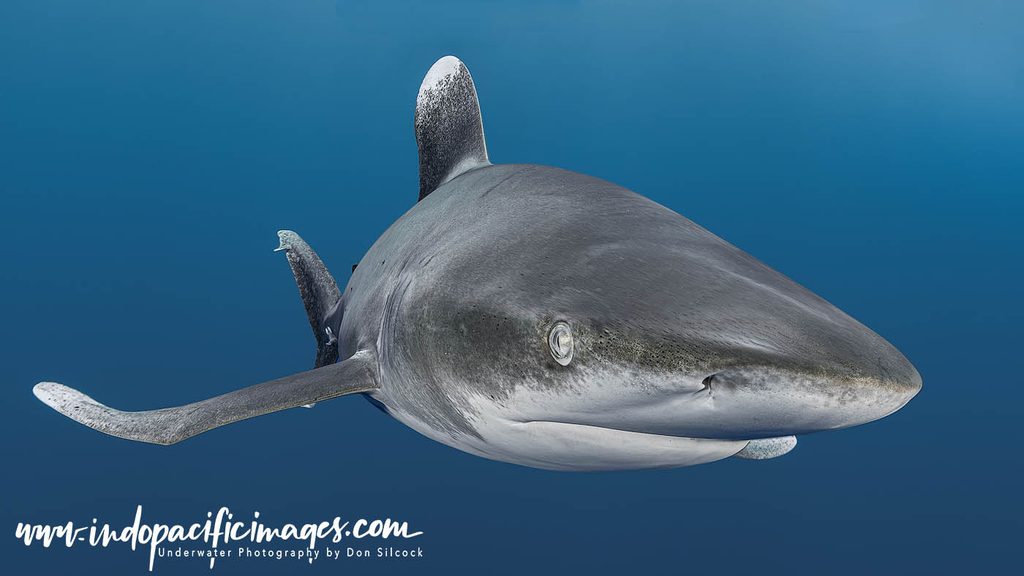
Their large, almost wing-like pectoral fins are one of their most distinctive features. The scientific name longimanus translates roughly as “long hands”, an appropriate reference to those unusually elongated fins.
There is something particularly impressive about seeing an animal that has evolved to live in such an immense environment suddenly appear out of the blue and come directly towards you.
Return of the Oceanic Whitetip Sharks
Oceanic Whitetips were once common in the offshore waters around the Bahamas. But from around the early 1980s they became increasingly rare.
And it was generally assumed that intensive longline fishing had effectively removed them from the region.
Longline fishing is particularly damaging to pelagic sharks because it operates in exactly the same part of the ocean that Oceanic Whitetips use.
A single longline can stretch for many kilometres and carry thousands of baited hooks intended to catch tuna, swordfish and other valuable pelagic species.
Oceanic Whitetips are not necessarily the intended target, but they are attracted to the same bait and can become a significant component of the by-catch.
Their large fins have also historically made them valuable in the international shark-fin trade. The result has been catastrophic declines in oceanic whitetip populations across much of their former range.

But the Bahamas took a different path and the government banned longline fishing in the early 1990s as part of broader measures to protect its marine resources. For a species that had been largely eliminated from the surrounding waters, the significance of that decision would only become apparent more than a decade later.
But it took another year or so for the significance of what was happening to become clear. Oceanic Whitetips had returned – and not just one or two transient individuals. There appeared to be a population gathering around Cat Island.
A Significant Discovery
Quite who first recognised the significance of the Cat Island sharks is difficult to establish. As both a BBC film crew and National Geographic photographer Brian Skerry were reportedly following the same lead at around the same time.
What is not in doubt is the importance of the discovery.
Here, on the south-eastern tip of Cat Island, was a population of oceanic whitetips apparently doing something that had become increasingly unusual elsewhere in the world.
They were returning to protected Bahamian waters. And the discovery also created an extraordinary opportunity for scientists.
Oceanic whitetips are notoriously difficult to study because they spend their lives in the open ocean and can travel enormous distances.
Cat Island provided something that had previously been almost impossible: a predictable aggregation where individual sharks could be encountered, identified and tagged.
Serious research began in 2010, and more than 100 oceanic whitetips have subsequently been fitted with satellite tags.
The results have revealed just how wide-ranging these animals can be. With some tagged sharks travelling as far as 2,000km from Cat Island. Yet, despite those impressive journeys, the sharks have generally spent much of their time within the protected waters of the Bahamas.
Where are the Breeding and Birthing Grounds?
That finding is really important as it demonstrates both the mobility of oceanic whitetips and the value of large areas of effective protection. Furthermore, many of the sharks encountered are females, including pregnant females. But there has been no indication that Cat Island itself is where they give birth. Which leaves a fascinating conservation question still to be answered – where are the breeding and birthing grounds?
There have been indications that the northern coast of Cuba could be important. With reports of juvenile Oceanic Whitetips around the small village of Cojímar near Havana. If those areas prove to be significant nursery habitat, protecting them would become an important part of completing the conservation picture.
Diving with Oceanic Whitetip Sharks
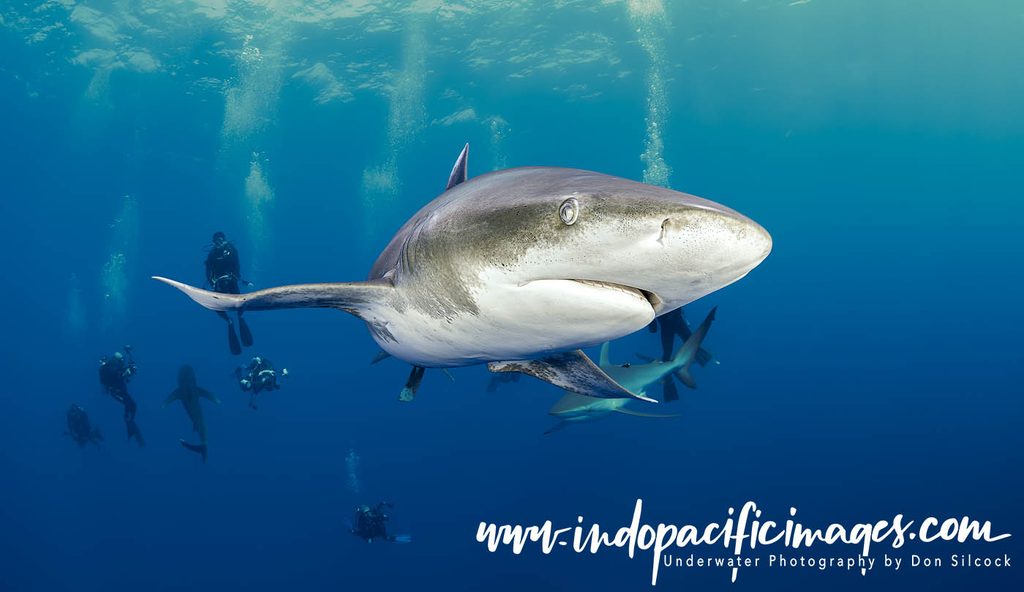
The Bahamas is well known for its exceptional shark encounters, including Tiger Sharks at Grand Bahama and Great Hammerheads at Bimini. And while both experiences are excellent, they are also generally relatively structured. You are often positioned on or close to the seabed, with the sharks approaching across a fairly predictable horizontal plane.
Cat Island is completely different – it is a genuinely three-dimensional experience. There is no reef or sandy bottom to focus on, and no obvious visual reference apart from the white bait crate suspended at around 10m. You are simply hanging in the blue water with the Atlantic extending in every direction. And then an Oceanic Whitetips appears.
The sharks are attracted by the scent of the bait in the crate. But they are not actually fed, as the scent is enough to keep them interested. And interested indeed they are… Approaching with extraordinary confidence, often coming close – very close!
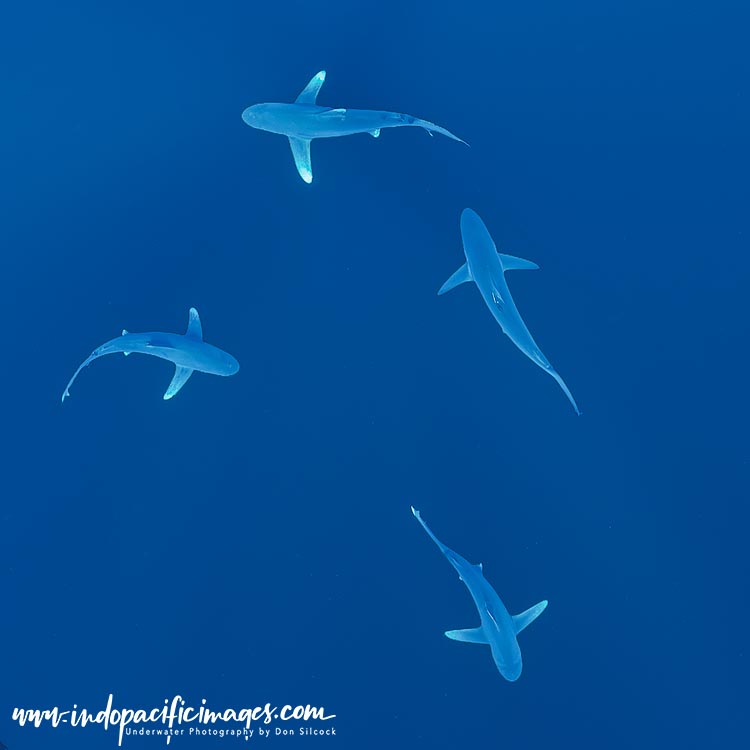
They do not necessarily approach from the front either. One can appear from behind, another from above and another from somewhere below. They may circle, change direction and disappear into the blue before reappearing from a completely different angle.
That constant movement is what makes the Cat Island experience so different.

Oceanic Whitetip Sharks – Behaviour
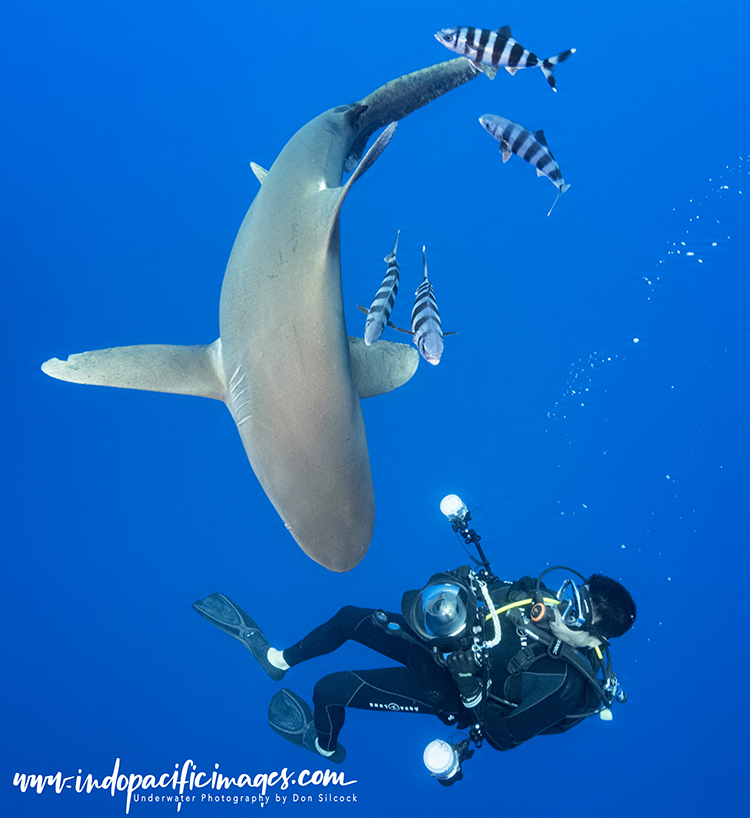
Oceanic Whitetips have an intimidating reputation, and with good reason. They are large, powerful predators that can reach close to four metres in length. Their broad pectoral fins and distinctive rounded dorsal fin give them an unmistakable appearance, while their confident movements convey a sense of complete ownership of the water around them.
But what really stands out underwater is their curiosity. They appear to have very little fear of divers and can approach extraordinarily closely. Physical contact is not unusual, with a shark sometimes brushing against a diver or camera.
For someone experiencing oceanic whitetips for the first time, that behaviour can feel quite intimidating. My impression, however, was that much of it was investigative rather than overtly aggressive. The sharks seemed to be assessing what was in their environment, repeatedly approaching and then changing direction.
That inquisitiveness is part of what makes them so fascinating to observe. There is also something wonderfully appropriate about the way they move. Those enormous pectoral fins allow them to glide slowly and efficiently through the water, conserving energy as they travel over huge distances.
Photographing Oceanic Whitetip Sharks
For an underwater photographer, the three-dimensional nature of the Oceanic Whitetip encounters creates both opportunities and challenges. There is no bottom to use as a background and no predictable direction from which the sharks will arrive – they can appear from almost anywhere.
Wide-angle lenses are therefore essential, but the challenge is not simply getting close enough. As the sharks come close themselves and the real challenge is anticipating what they will do next.
An Oceanic Whitetip may be approaching head-on one moment and then suddenly veer away, pass underneath or appear over your shoulder. Which makes situational awareness just as important as camera technique. It also creates the possibility of images that are very different from the more conventional shark photographs taken over a reef or sandy seabed. There is nothing behind the shark except the immense blue expanse of the Atlantic.
When the composition works, the result conveys something of the animal’s true environment — an truly pelagic predator in an equally enormous ocean.
Why Cat Island Matters
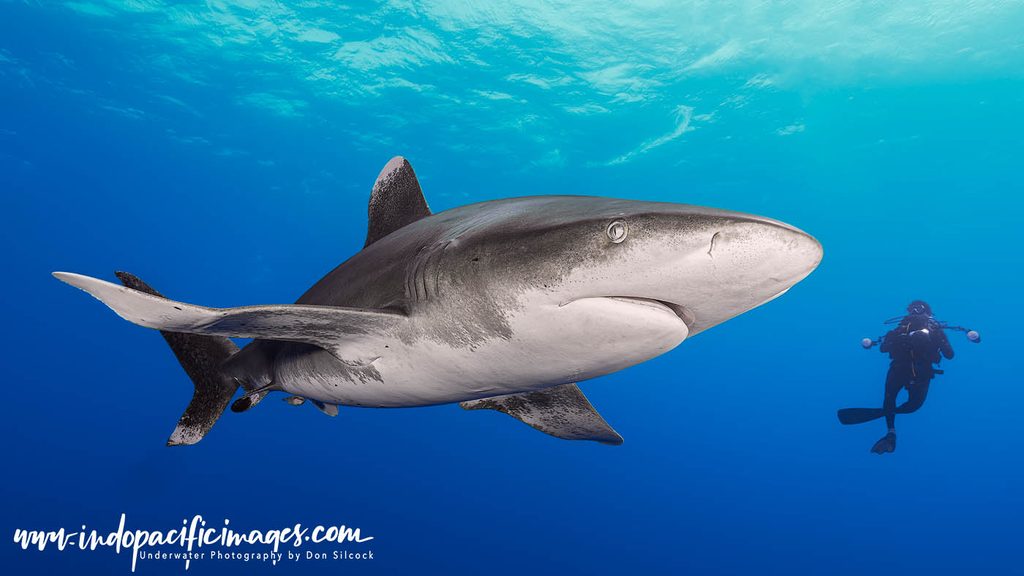
The return of oceanic whitetips to Cat Island is more than simply a great story for shark divers. It is an example of what can happen when vulnerable marine predators are given meaningful protection.
The Bahamas recognised the importance of protecting its marine environment early. The establishment of the Bahamas National Trust in 1959 led to the creation of the Exuma Cays Land & Sea Park, one of the world’s earliest marine protected areas.
Since then, the country has progressively expanded its network of protected areas.
In 2011, the Bahamas went further. Becoming the fourth country in the world to establish a national shark sanctuary, protecting sharks throughout Bahamian waters.
The return of oceanic whitetips to Cat Island would almost certainly not have happened without those protections.
The sharks are still vulnerable and the Cat Island population remains small.
But their presence demonstrates the remarkable resilience of nature when the pressures placed upon it are reduced.

There is also an important economic lesson here. A living shark can generate value through carefully managed tourism year after year, whereas a dead shark provides only the short-term value of its fins and meat. For Cat Island, the oceanic whitetips are therefore not simply an extraordinary natural asset. They are a reason to protect the surrounding marine environment.
And for divers, they provide something increasingly rare: the opportunity to enter the open ocean and encounter one of the world’s great pelagic predators on its own terms.
The Oceanic Whitetip Sharks of Cat Island
My experience at Cat Island left me with a much greater appreciation of just how different oceanic whitetips are from the sharks encountered at many of the world’s established shark-diving destinations.
They are not reef sharks waiting for an easy meal, animals tied to a particular patch of seabed. They are ocean wanderers.
Seeing them in that environment — suspended in deep blue water, with nothing but the sharks and the vast Atlantic around you — provides a much better sense of what these animals really are.
And perhaps that is the most memorable part of the experience.
For a few weeks each year, Cat Island offers a window into the world of the Oceanic Whitetip. It is an extraordinary privilege to be able to look into the blue and watch these magnificent sharks return.