
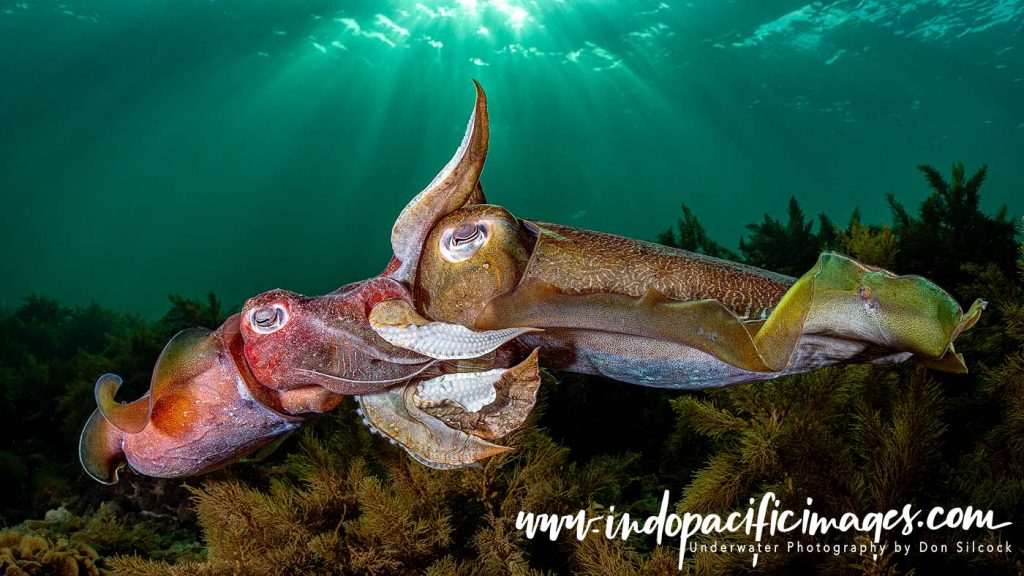
Australian Giant Cuttlefish… Each year, as the southern winter approaches, one of the world’s most extraordinary marine events unfolds in the shallow, cold waters of South Australia’s Spencer Gulf.
In a remote corner of the coastline, thousands of Australian Giant Cuttlefish (Sepia apama) congregate in a pulsating, color-shifting display of life, death, and legacy. This is not merely a gathering – it is a primal theater of biological brilliance. It remains the only place on Earth where this mass aggregation occurs with such density and predictability, offering divers and underwater photographers an uninhibited window into the lives of the “Chameleons of the Sea.”
The Australian Giants are the undisputed heavyweights of the cephalopod world. Reaching impressive overall lengths of up to one meter and weighing in at over 10kg, they dwarf their cousins found elsewhere in the Indo-Pacific. They are truly the master shape-shifters of the ocean and possess an almost supernatural ability to transform not just their skin color in a fraction of a second. But also their physical texture and body shape to mimic the surrounding kelp, sand, or rock.
The Annual Whyalla Aggregation: A Natural Phenomenon
While Sepia apama are found in solitary pockets throughout the temperate waters of southern Australia, the Whyalla Cuttlefish Aggregation is a unique geographical anomaly. Between May and August, tens of thousands of these intelligent creatures migrate from across the Great Southern Reef to a specific, localized stretch of rocky shoreline near Point Lowly.
Driven by a “live fast, die young” evolutionary strategy, they have a lifespan of only 12 to 24 months, making this single spawning event the culmination of their entire existence.
Why Whyalla? The secret lies in the geology of the northern Spencer Gulf. The shallow, fractured rocky ledges provide the perfect protective substrate for females to wedge their leathery, lemon-shaped eggs, shielding them from predators and the surge of the Southern Ocean.
For the visitor, the beauty of this event lies in its accessibility. Because the primary action occurs in depths of often less than 5m, the spectacle is accessible to scuba divers and snorkelers alike. In these cold and often clear waters, you aren’t just an observer; you are immersed in a swirling kaleidoscope of “passing cloud” skin patterns and dramatic territorial battles that look like something from a science-fiction epic.
The Australian Giant Cuttlefish Annual Aggregation – A Complete Guide
The Giant Australian Cuttlefish
The Whyalla Cuttlefish Aggregation
Cuttlefish Conservation in Whyalla
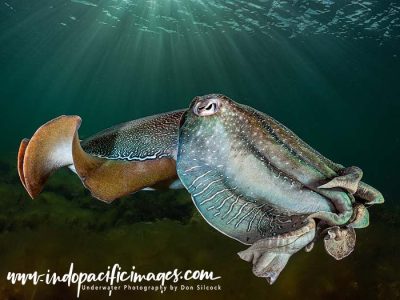
Photographing Giant Australian Cuttlefish
Photographing Giant Australian Cuttlefish… The annual aggregation in Whyalla is one of the world’s most accessible marine spectacles. But, because the water is shallow and the animals are bold, the challenge isn’t finding them – it’s managing the cold and capturing their incredible light …
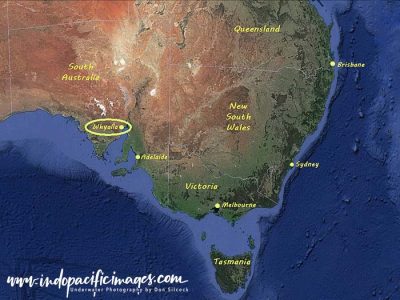
Whyalla Logistics
Overview of Whyalla and Diving Logistics… A trip down to South Australia for the annual cuttlefish aggregation is really quite straightforward. The aggregation literally happens just off the beach, so it is all shore-diving – no boats required… So you just need to know which beach, …
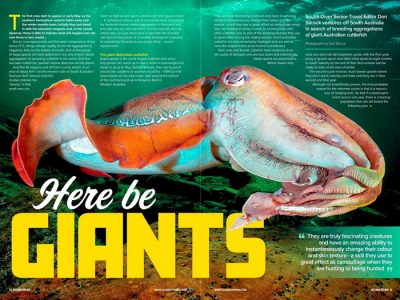
The Amazing Australian Giant Cuttlefish
The Amazing Australian Giant Cuttlefish… The first ones start to appear in early May, as the southern hemisphere autumn fades away and the winter months loom. Initially they just blend in with the abundant seagrass and, to the casual observer, there is little to indicate what will happen over …
Back To: Scuba Diving in Australia