Diving the Ogasawara Islands… Often referred to as the “Oriental Galapagos”, the remote Ogasawara Islands lie more than 1,000km south of Tokyo in the western North Pacific. Volcanic, subtropical and remarkably isolated, they are one of the most remote parts of Japan. And a destination where the journey is very much part of the experience.
The Ogasawara Islands
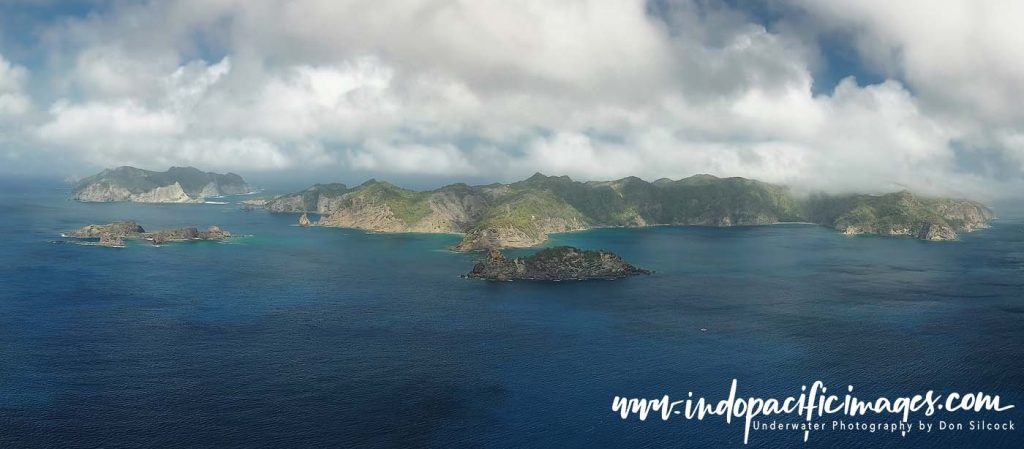
The Ogasawara archipelago consists of more than 30 subtropical and tropical islands scattered across a vast area of the western Pacific.
Despite their considerable distance from mainland Japan, the islands are administered by Tokyo. And getting there is an adventure in itself.
There are no commercial airports on the islands. So for most visitors the only practical way to reach Ogasawara is by sea, aboard the regular ferry from Tokyo to Chichijima.
That isolation is one of the defining characteristics of the Ogasawaras. The islands are oceanic in origin and have never been connected to a continent.
Over immense periods of time, that isolation has allowed plants and animals to evolve independently, producing a remarkable collection of endemic species.
It is this evolutionary isolation that has earned Ogasawara its “Oriental Galapagos” nickname.
The islands are visually spectacular, with volcanic mountains rising steeply from deep surrounding waters. While rugged cliffs, forest-covered slopes and white-sand beaches give the larger islands a distinctly tropical appearance.

Ogasawara lies at a similar latitude to the better-known islands of southern Japan. The climate is subtropical, with warm temperatures throughout much of the year. The surrounding waters are equally interesting, with healthy coral reefs and abundant tropical fish life. But it was not the reefs that persuaded me to make the long journey south from Tokyo.
It was the possibility of encountering the larger inhabitants of the Pacific. Humpback whales visit the islands seasonally, while a resident population of sperm whales inhabits the deep offshore waters. Dolphins are also regularly encountered around Chichijima.
And that combination of remoteness and big-animal encounters was simply too tempting to ignore.
Getting to the Ogasawara Islands
Simply travelling to Ogasawara is an experience in itself — and one that quickly immerses you in a fascinating combination of Japanese culture, extraordinary infrastructure and impeccable organisation.
My journey began in Bali with a flight to Tokyo’s Haneda Airport. From there I had to make my way across Tokyo to Takeshiba Pier, where the Ogasawara ferry departs.
That sounds straightforward enough. But when you have a substantial amount of diving and underwater photography equipment with you, navigating Tokyo’s excellent but initially bewildering railway system becomes a logistical exercise in its own right!
Boarding the Ogasawara Maru is conducted with the characteristic Japanese combination of courtesy and efficiency.
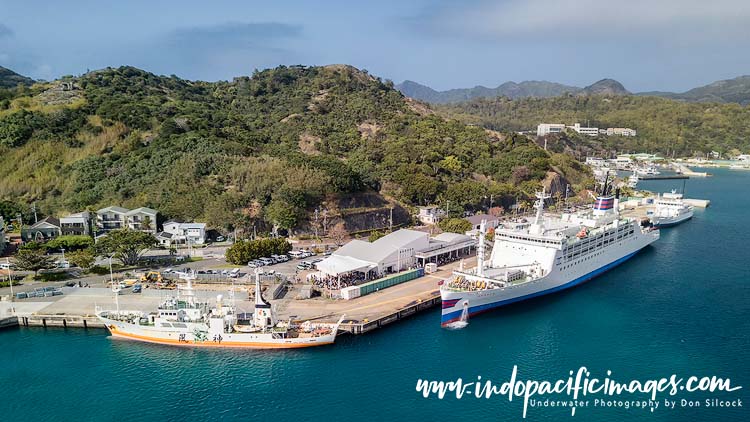
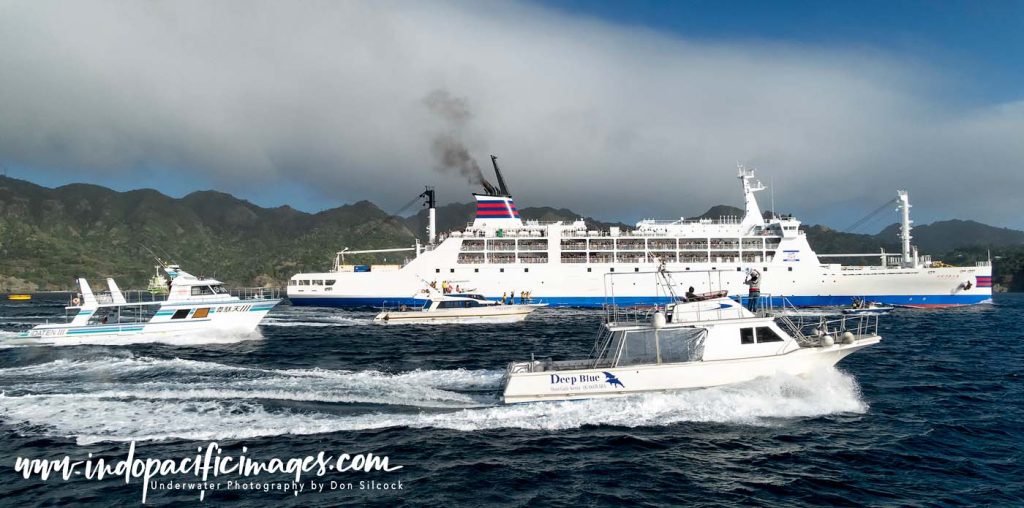
And once aboard, you quickly realise that foreign visitors are very much in the minority. The ship itself is comfortable and well equipped, with restaurants, vending machines and everything else you might reasonably need for the approximately 24-hour voyage to Futami Port on Chichijima.
The crossing is a fascinating part of the adventure. Tokyo gradually disappears behind you and, hour by hour, the huge expanse of the Pacific takes over. And when Chichijima finally appears on the horizon, its steep volcanic slopes rising dramatically from the ocean, you know that you have arrived somewhere genuinely remote.
The return journey is equally memorable. When the Ogasawara Maru prepares to leave Chichijima, locals turn out to see the ship off. Boats gather around the ferry and follow it as it departs, creating a surprisingly emotional farewell.
Diving the Ogasawara Islands
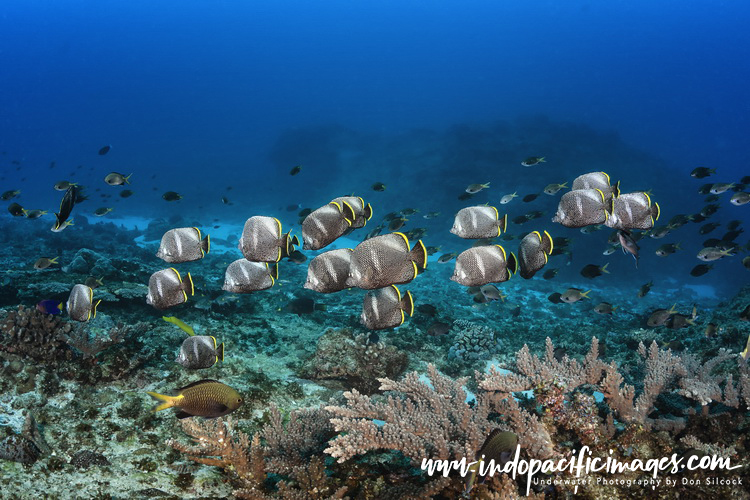
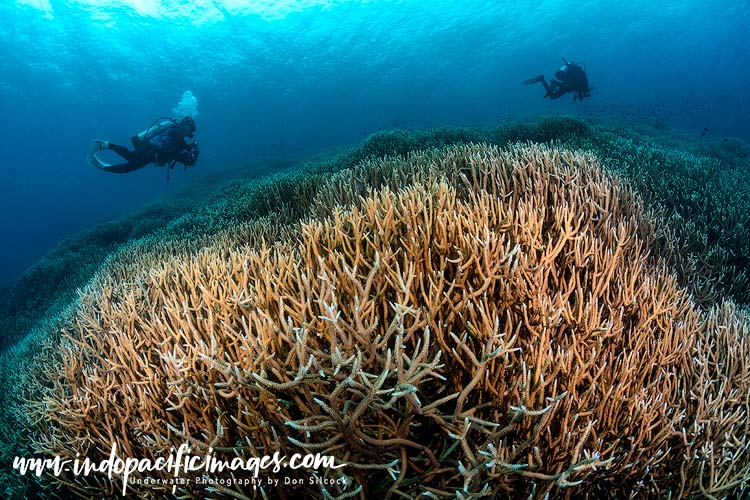
The main diving area around Chichijima consists of a mixture of coral reefs, rocky underwater terrain and deeper offshore environments. And the reefs I experienced were generally in very good condition, with healthy hard corals and a wide variety of tropical reef fish.
One particularly interesting species is the wrought-iron butterflyfish (Chaetodon daedalma). A striking butterflyfish endemic to the waters around southern Japan and relatively common around Ogasawara.
While the reefs are healthy and the diving is enjoyable. Personally, I would not put Ogasawara at the top of the list for spectacular coral-reef diving. Which might sound like a strange thing to say about a place often described as the Oriental Galapagos.
But it is important to distinguish between the quality of the reef diving and the quality of the overall experience.
Diving the Ogasawara Islands – Sand Tiger Sharks
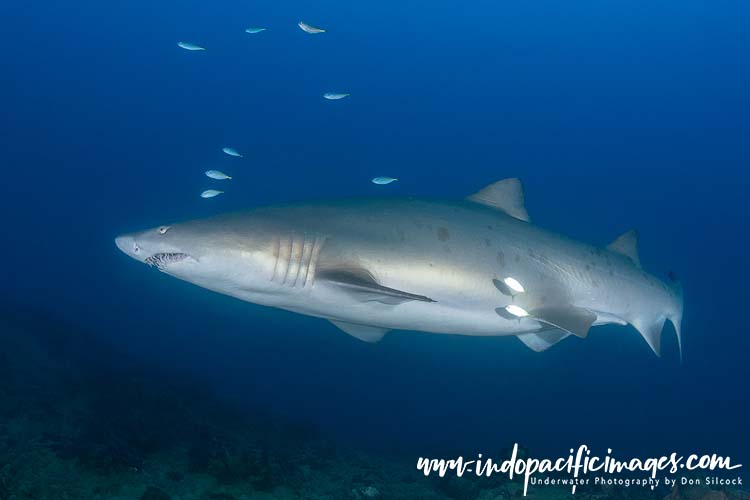
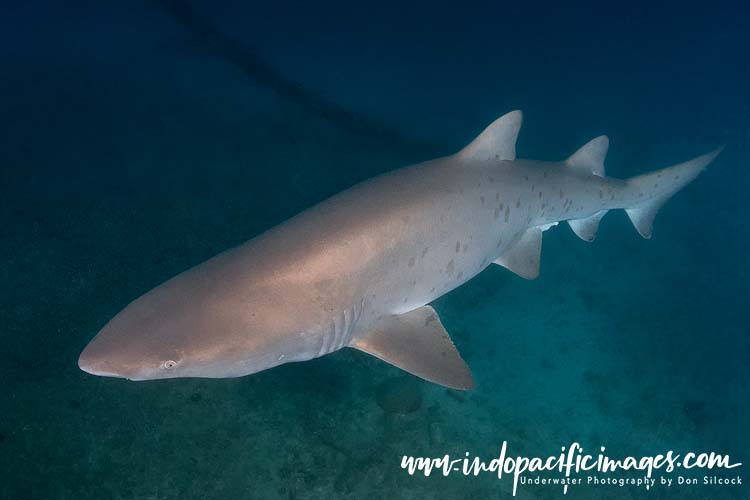
One of the more unusual encounters around Chichijima involves sand tiger sharks that congregate in the vicinity of Futami Port. The sharks can often be found around a wreck on the eastern side of the large bay at the entrance to the main harbour.
Interestingly, they also enter the harbour at night to hunt. And because Futami is a working harbour, the sharks can sometimes be seen from the surface in the lights around the pontoons.
It is a somewhat surreal experience to look into the dark water of a Japanese harbour and see large sharks moving through the illuminated water below.
Diving the Ogasawara Islands – Dolphins
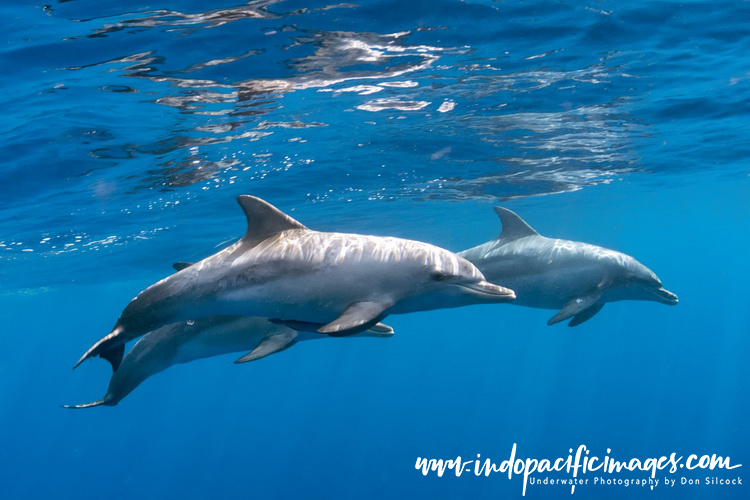
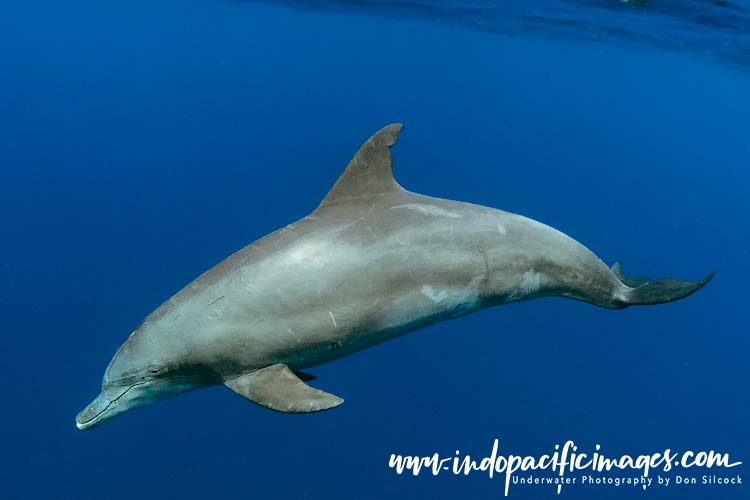
Dolphins are another major attraction. Both spinner dolphins and bottlenose dolphins occur around Chichijima. And encounters with them can be spectacular when conditions are right.
There is obviously no guarantee that a pod will be interested in divers. But when dolphins decide to interact, the encounter can be one of the most memorable experiences of a trip.
And this is really where Ogasawara starts to reveal its character. You are not simply travelling to another Japanese reef destination.
You are travelling to a group of isolated oceanic islands surrounded by deep Pacific water — and the wildlife reflects that.
Diving the Ogasawara Islands – Humpback Whales
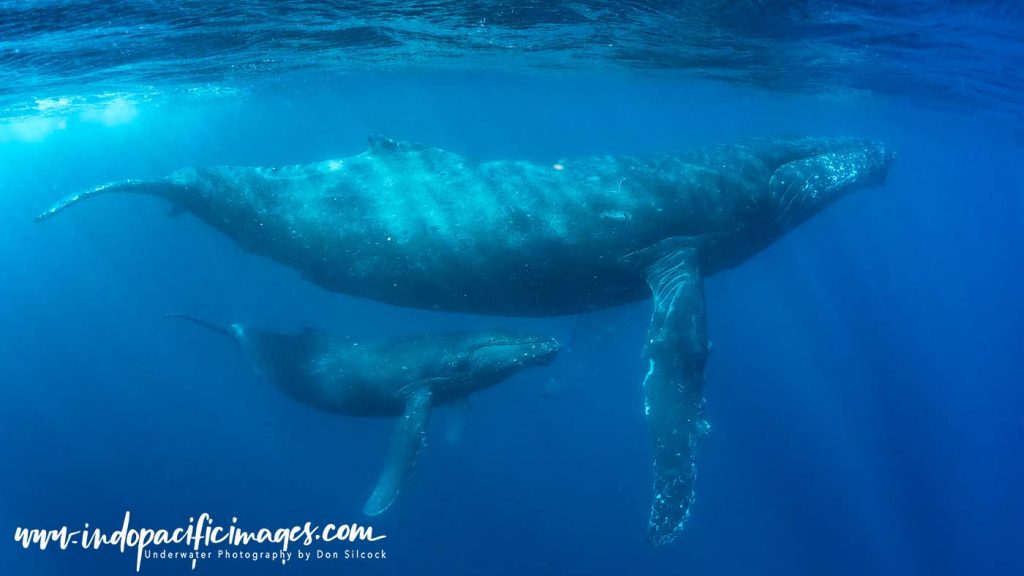
Northern humpback whales are one of the Ogasawara archipelago’s major attractions. They arrive in the waters around Chichijima during the cooler months, with the main season running from February through April.
They are a familiar sight around the islands and an important part of the local tourism industry.
But there is an important distinction between watching humpback whales and actually getting into the water with them.
Deliberate in-water encounters are not permitted, with a 100m exclusion zone applying around the whales.
However, if you are already in the water and a curious whale decides to swim towards you and check you out, that’s different.
Because the encounter is happening entirely on the whale’s terms — and all is well in the world!
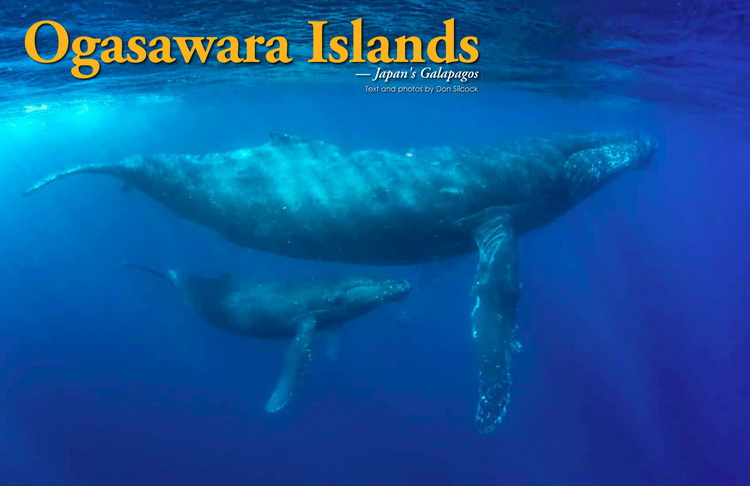
That only happened once during my trip, when a mother and calf briefly approached me before turning away and passing by.
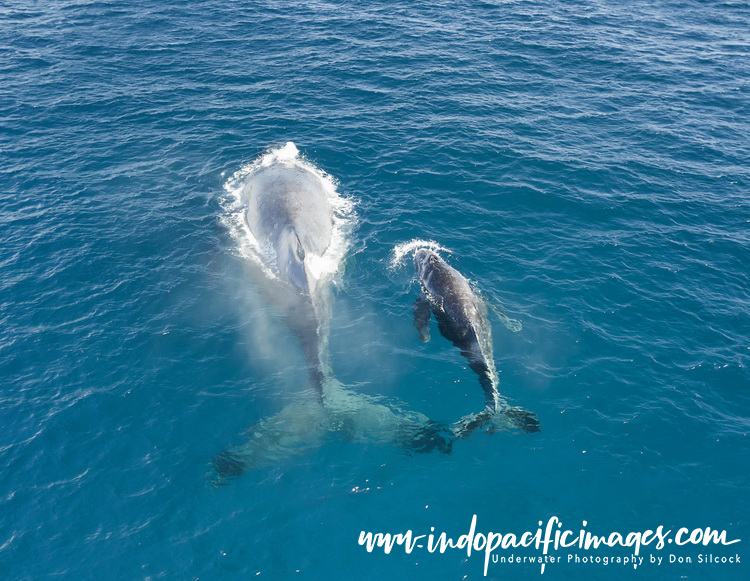
It was a fleeting encounter, but an unforgettable one. And I think of it as a kind of “drive-by whaling” — the mother and calf simply cruised past for a quick look before continuing on their way.
Diving the Ogasawara Islands – Sperm Whales
If humpbacks are the seasonal visitors, sperm whales are the permanent residents. Ogasawara supports a small resident population of sperm whales. Although finding them is a very different proposition from encountering the humpbacks around Chichijima.
The sperm whales generally favour the deep offshore waters, rather than the shallower coastal areas around Chichijima and Hahajima.
During my visit, the main area of interest was roughly 10km offshore around the deep waters southeast of Chichijima. The best conditions for finding them are generally associated with the calmer summer months, particularly August and September.
As with the humpbacks, in-water encounters with sperm whales are subject to exclusion rules.
The Japan Grounds
The waters around Ogasawara also have an intriguing connection with the history of whaling. During the early 19th century, when commercial whaling was reaching its peak, the surrounding ocean became known as the “Japan Grounds” because of the abundance of whales.
At the time, Japan was still largely closed to foreigners, and the isolated Ogasawara Islands provided a useful place for ships to obtain fresh water, food and other supplies. The islands subsequently developed a complicated history involving Japanese settlement, foreign residents, military occupation and American administration.
That history is still visible in various ways around Chichijima and adds another layer to the experience of visiting the islands.
The History of the Bonin Islands
Ogasawara is also known as the Bonin Islands, a name believed to have originated from the Japanese word bunin, meaning uninhabited or without people.
The islands were claimed for Japan in the 16th century following their discovery by Ogasawara Sadayori, although they remained largely uninhabited for many years. A small settlement of Westerners and Pacific Islanders was established on Chichijima in the 19th century.
Japan formally asserted sovereignty over the islands in 1875, and their strategic position later made them important military bases during the Second World War. Following the end of WWII, the islands came under United States administration before being returned to Japan in 1968.
Today, however, the atmosphere is far removed from those turbulent years. Chichijima is a small, friendly island community surrounded by quite spectacular natural scenery.
Chichijima and Hahajima
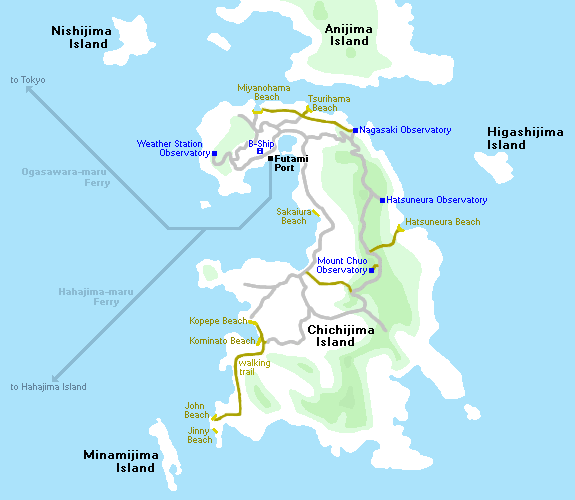
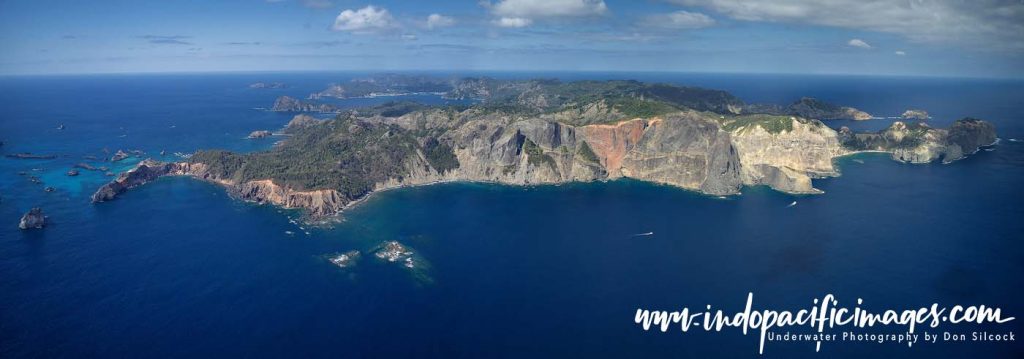
Only two of the Ogasawara Islands are permanently inhabited. Chichijima, or “Father Island”, is the larger and more developed of the two and is home to roughly 2,500 people.
Chichijima is also the administrative centre and the main gateway to the archipelago. The island is mountainous and heavily forested, with steep volcanic slopes, rugged cliffs and attractive white-sand beaches.
It is also the centre of the region’s whale- and dolphin-watching activities.
Hahajima, or “Mother Island”, lies approximately 40km south of Chichijima. It is smaller, quieter and considerably less developed, and is reached by ferry from Chichijima.
For visitors looking for remoteness, however, even Chichijima can feel a very long way from the rest of Japan.
And that is precisely what makes it so appealing.
Immersion Therapy
It is a long way to get to the Ogasawara Islands. For an international visitor, the journey can easily consume two days each way. With one day to reach Tokyo and then another 24 hours aboard the ferry to Chichijima.
So why go?
For me, the answer was not simply the diving. Which is good around Chichijima, but I would not describe it as spectacular. And encounters with whales and dolphins are never guaranteed. But Ogasawara is about much more than individual dives. It is about the experience of being somewhere genuinely remote.
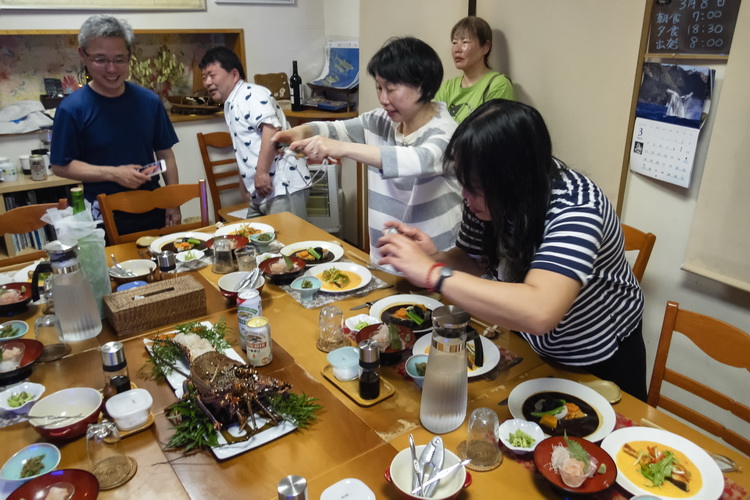
There are no huge international resorts where you can retreat behind a familiar façade of air-conditioned rooms, restaurants and swimming pools. Instead, visitors typically stay in small pensions and guest houses and that makes a big difference. As you are much more closely connected to the local community. Eating local food, meeting the people who live there and experiencing a very different side of Japanese life. For me, that was probably the highlight of the entire trip.
Japan is one of my favourite countries and never fails to amaze me. The cities are extraordinary, with their incredible infrastructure, technology, culture and sheer efficiency. But the smaller towns and villages offer something completely different. And Ogasawara takes that experience to another level. You are more than 1,000km from Tokyo, surrounded by ocean, staying in a small island community and sharing the place with people whose lives are intimately connected to the sea.
That is a very different Japan.

Is Ogasawara Worth the Journey?
Absolutely — but perhaps not for the reasons you might initially think. If you are travelling halfway around the world specifically in search of the most spectacular coral reefs in Japan, there are other destinations that deserve consideration.
But if you want something genuinely different, Ogasawara is difficult to beat. The islands combine extraordinary isolation with healthy reefs, endemic wildlife, dolphins, sharks and the possibility of encounters with some of the largest animals in the ocean.
Then there is the journey itself. The long ferry ride from Tokyo, the tiny island community, the guest houses, the local food and the feeling of being somewhere that very few international visitors ever reach.
For me, that combination is what makes Ogasawara special. The “Oriental Galapagos” nickname may have been created to describe the islands’ remarkable evolutionary isolation.
But it also captures something about the overall experience. Ogasawara feels different remote, wild and wonderfully Japanese.
X-Ray Magazine Article
I documented my whole experience in Bimini in a comprehensive six-page article that was published recently in the global dive magazine X-Ray.
You can use this link to download the Diving the Ogasawara Islands article.