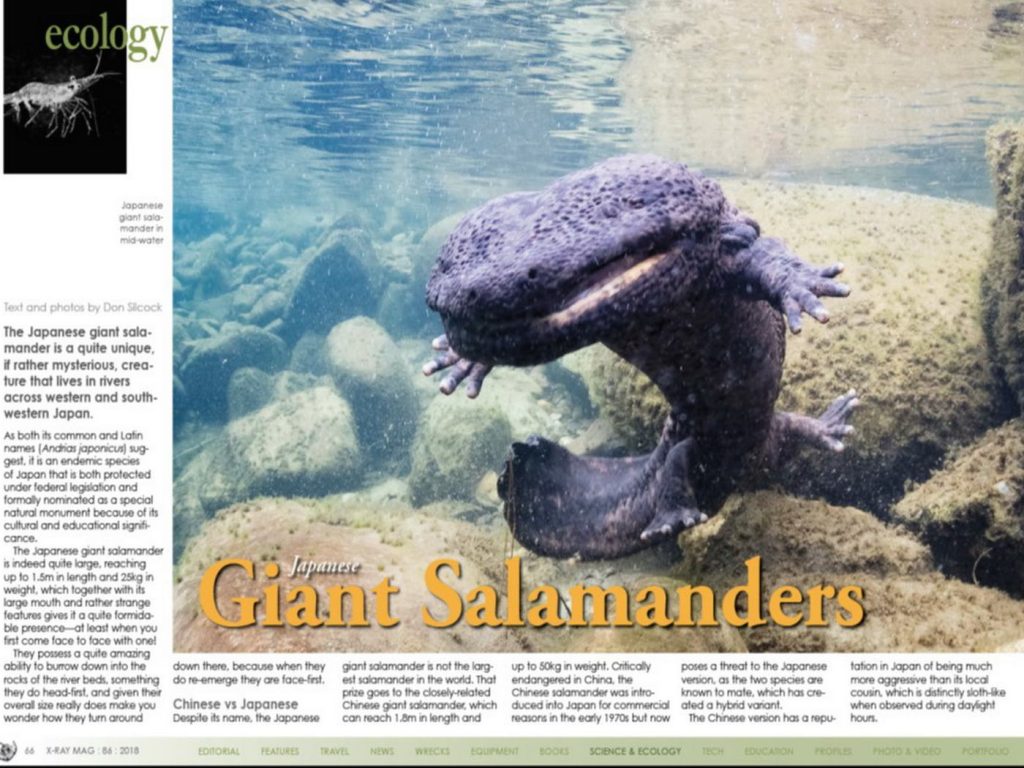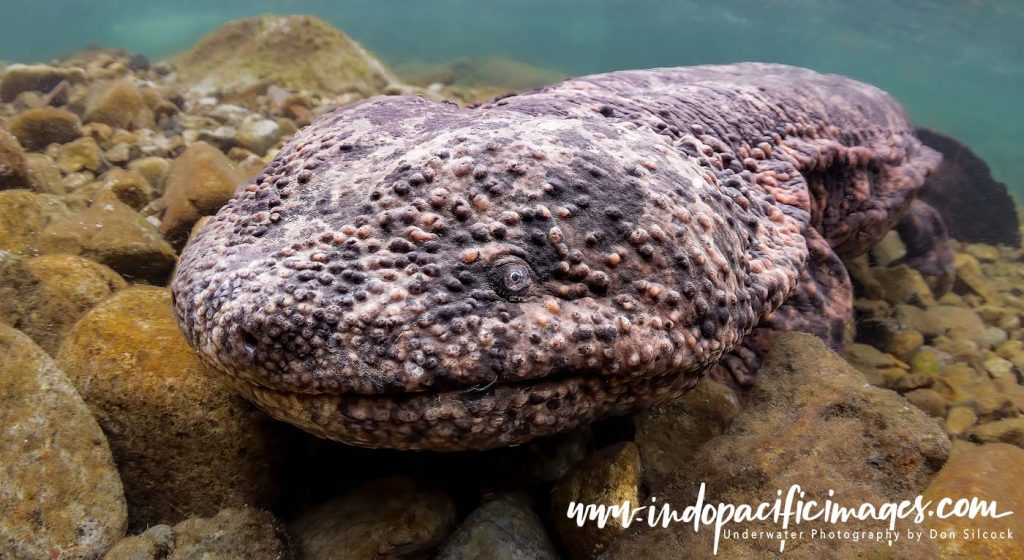
The Giant Japanese Salamander is one of the strangest creatures I have ever encountered underwater.
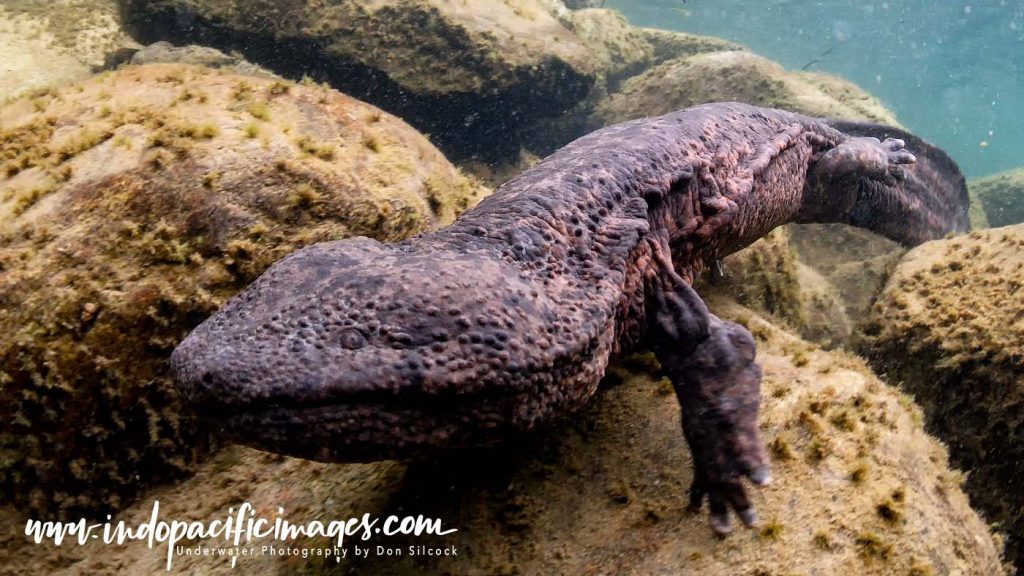
Endemic to Japan, Andrias japonicus is one of the world’s largest amphibians. Capable of reaching around 1.5m in length and weighing more than 20kg. It is also an extraordinarily elusive animal, spending much of its life hidden among the rocks of fast-flowing mountain rivers in western and south-western Japan.
Protected under Japanese national legislation. The species is also designated a Special Natural Monument because of its cultural, scientific and educational significance.
Despite its size, finding one is not easy. They are nocturnal, remarkably well camouflaged and spend much of the daylight hours tucked away beneath the rocks of the riverbed. And that makes encountering one underwater a rather unusual experience…
The large size of the Giant Japanese Salamander, combined with its enormous mouth and rather strange appearance, gives it a surprisingly formidable presence. And these ancient-looking amphibians are perfectly adapted to life in cool, fast-flowing rivers. As their mottled brown and black skin provides excellent camouflage against the rocks and gravel of the riverbed. While their flattened bodies allow them to shelter in crevices and beneath submerged rocks.
One of their most remarkable behaviours is their ability to burrow deep into the rocks and sediment of the riverbed. They often disappear head-first into these underwater retreats, leaving very little of the animal visible.
Which inevitably raises a question… How on earth do they turn around down there? Because when they eventually re-emerge, they generally appear to come out head-first!
Waiting Patiently for the Giant Japanese Salamander…
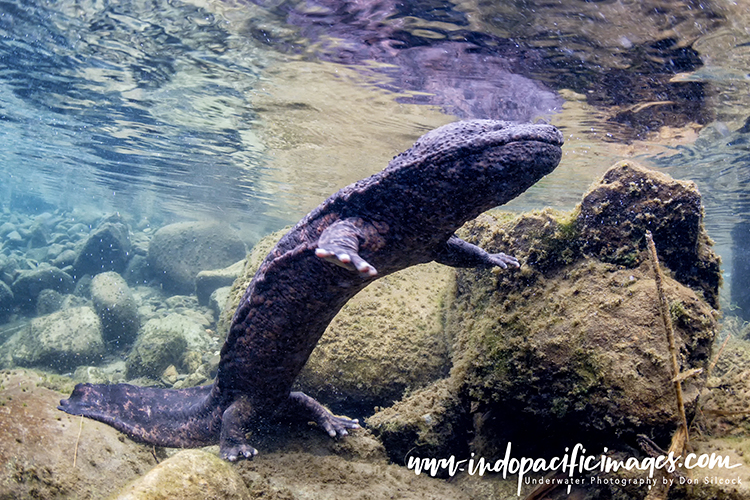
Giant Japanese Salamanders are nocturnal creatures and are therefore at their most active after night has fallen.
During daylight hours they tend to remain concealed, down in the river bed and emerging only periodically to breathe.
They lose their external gills as they mature and rely primarily on their lungs for respiration.
However, their highly vascularised skin also plays an important role in gas exchange, particularly in the cool, well-oxygenated water of their river habitat.
Being in the water with these creatures is therefore an interesting experience – but one that involves quite a lot of patience.
While the salamander is slumbering somewhere down among the rocks, there is not much to do except wait…
And watch the rocks!
Photographing the Giant Japanese Salamander
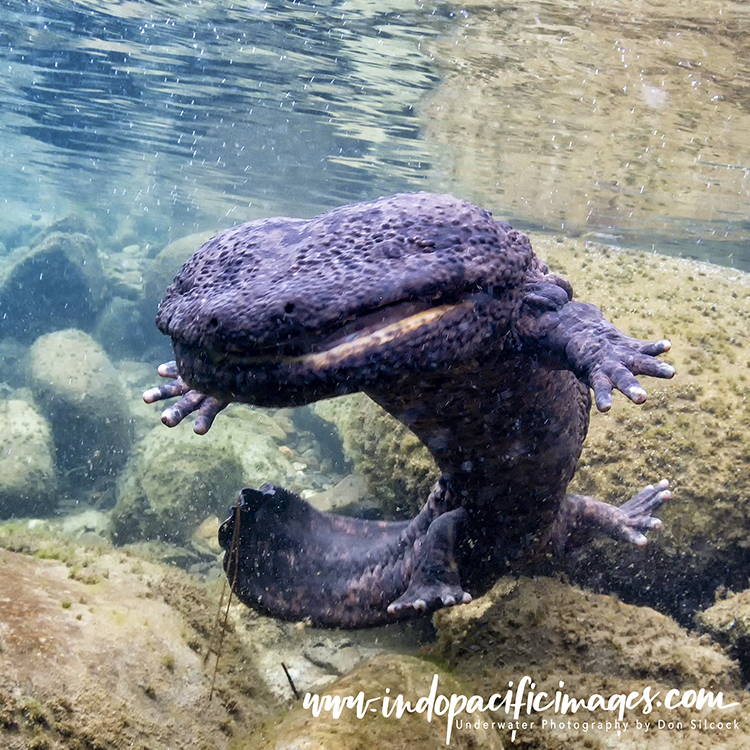
Photographing Giant Japanese Salamanders can be quite challenging. Their nocturnal lifestyle means that they are generally reluctant to move around during daylight hours, while their camouflage makes them surprisingly difficult to spot in the first place.
This is where having an experienced local guide becomes essential. A good guide knows the river and, more importantly, knows where the salamanders are likely to be hiding.
Without that knowledge, you could spend hours looking at what appears to be nothing more than an endless collection of rocks.
The salamanders are also very sensitive to light, and responsible encounters should avoid exposing them to bright artificial illumination.
For photography, this means relying on natural ambient light rather than strobes.
And that presents another challenge. Even in relatively shallow water, the conditions in a mountain river can be quite dark, particularly beneath overhanging vegetation or in deeper sections of the river.
A fast wide-angle lens and a camera capable of producing good results at higher ISO settings are therefore useful.
I used the versatile Tokina 10–17mm fisheye zoom with my Nikon D500 and Nauticam housing.
Wide angle is definitely the way to go. These are large animals, and getting close enough to fill the frame while maintaining a respectful distance produces the most interesting images.
Mid-water shots are particularly effective, But you have to be quick…
At the Surface
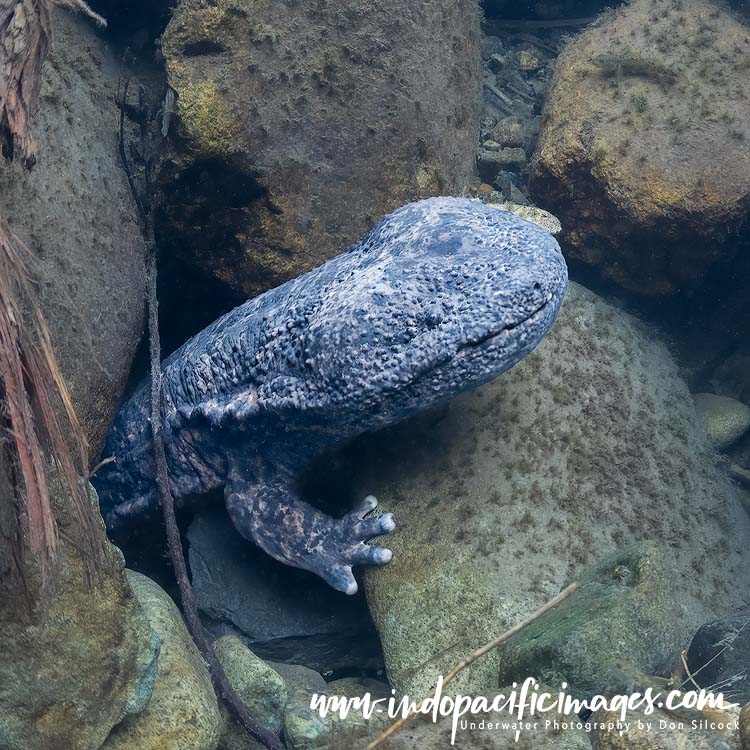
Giant Japanese Salamanders need to surface periodically to breathe, creating a rather unusual rhythm to the experience.
During my time with them, the routine was roughly 25 minutes of rock-watching, followed by a few minutes of increasingly purposeful movement as a salamander began to emerge from the riverbed.
Then came the action. The salamander would suddenly make a determined ascent towards the surface, take a breath and then retreat back into the rocks from where it had emerged.
The entire episode could be over in little more than a minute.
So you need to be ready. Camera settings have to be prepared in advance, composition needs to be anticipated and, most importantly, you need to be watching the animal rather than fiddling with your camera.
If you are patient – and have a touch of luck – you may encounter one of the salamanders out in the open.
If that happens, all of your stalking skills will be required.
Slow, deliberate movements are essential, as the animals can be quite cautious. Taking your time and allowing the salamander to become accustomed to your presence can eventually get you close enough for some excellent images of these remarkable creatures.
Where to See the Giant Japanese Salamander?
The first thing you will need if you want to see a Giant Japanese Salamander is a guide.
Without one, your chances of finding a salamander are extremely small. They live in rivers in rural parts of Japan, and locating them requires detailed knowledge of the local habitat.
A Japanese-speaking guide is also highly desirable, as English is not widely spoken in many of the rural areas where the salamanders are found.
For my trip, I was very fortunate to have some excellent local help.
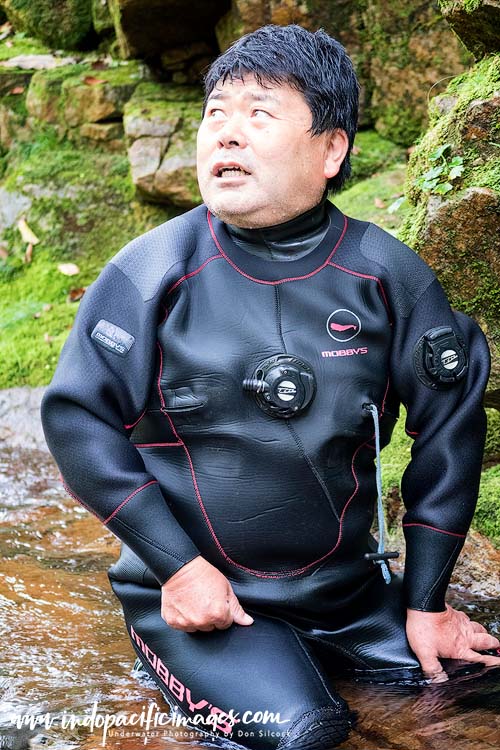
My diving buddy Martin lives in Tokyo and is fluent in Japanese, having grown up with an American father and Japanese mother. Martin put me in touch with Yoshihiro Ito, who has developed an almost legendary reputation for his knowledge of Japan’s salamanders.
Ito-san is one of those people whose enthusiasm for his subject is immediately obvious.
He turned a lifelong obsession with the wildlife of Japan into his full-time occupation, giving up a good career as a sales manager in the process.
And that decision has allowed him to spend his time doing something he clearly loves – finding and sharing Japan’s remarkable wildlife.
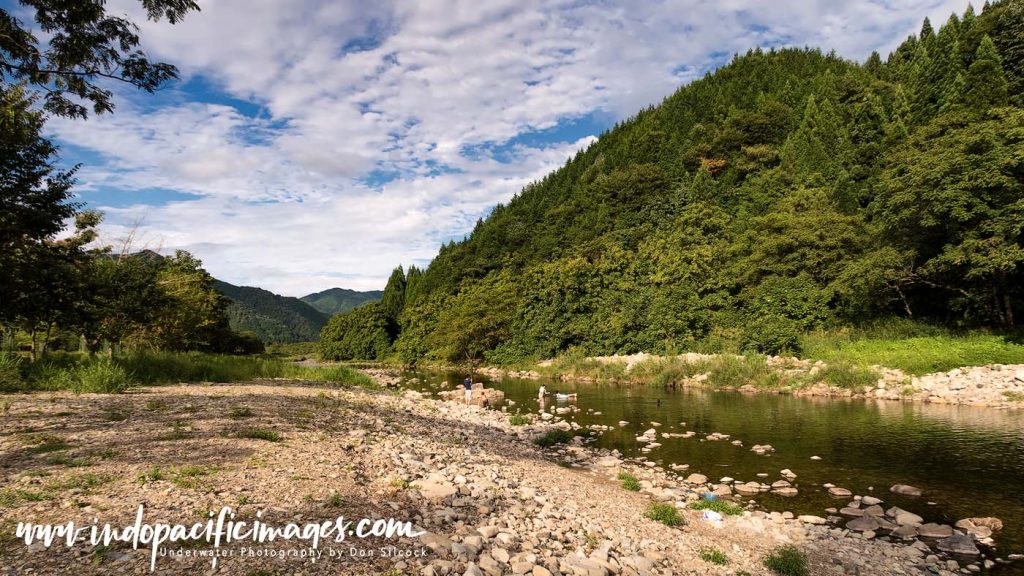
The Wara River in Gifu Prefecture
For my trip, the gateway was Gifu, the capital of Gifu Prefecture in the Chūbu region of central Japan. Gifu is easily reached from Tokyo by the excellent Japanese rail network. With the journey from Shinagawa Station taking roughly two hours by Shinkansen, depending on the service.
From Gifu, Ito-san collected us and drove into the mountains towards the small village of Wara and the surrounding river system.
The contrast with Tokyo could hardly have been greater. The journey took us away from the bright lights and extraordinary infrastructure of urban Japan and deep into a much quieter, rural landscape.
Once we arrived, we kitted up in dry suits and entered the river. Ito-san then guided us to some of the best locations to look for the salamanders. And so began our routine of rock-watching, waiting and watching some more…
Until eventually one of the rocks moved!
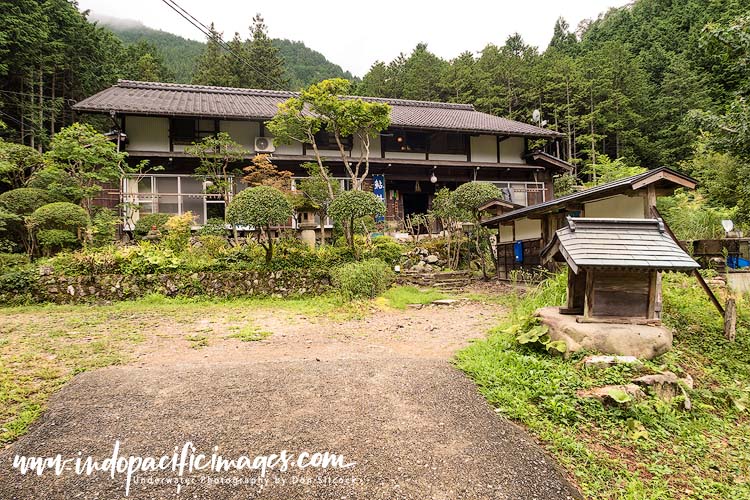
A Taste of Rural Japan
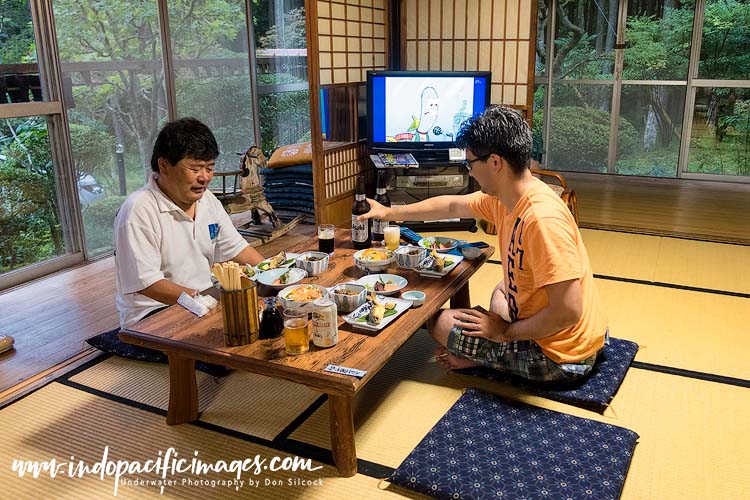
For me, the opportunity to stay at a traditional ryokan-style country inn was almost as enjoyable as the experience with the salamanders themselves.
Staying in a rural Japanese inn had been on my “to-do” list for many years. But with my Japanese limited to asking for a beer and saying thank you… Arranging something like this independently had always seemed rather difficult.
Travelling with Martin and Ito-san changed all that. And we ate Japanese-style meals in the inn’s dining room alongside other travellers passing through the area. It was a wonderfully authentic experience and a welcome contrast to the large hotels and busy cities that most visitors to Japan experience.
The salamanders may have been the reason for the trip, but the opportunity to experience this quieter side of Japan became an important part of the adventure.
When to Go
The best time to encounter adult Giant Japanese Salamanders is generally associated with their breeding season in late summer. When mature animals become more active and move upstream into suitable mountain habitat.
During the breeding season, males establish and defend underwater nesting dens, where females deposit their eggs. The males then remain to guard the developing eggs. These large territorial males are commonly referred to as “denmasters“ and play an important role in the breeding process.
For anyone interested in seeing these remarkable animals, late August can therefore be an especially interesting time to visit.
But this is not a conventional wildlife encounter. There are no guarantees… You need the right river, the right conditions, an experienced guide and plenty of patience.
And then, of course, you need the salamander to cooperate.
An Unusual Japanese Diving Experience
Japan is famous for many things: ancient temples, Shinkansen, sumo wrestling, extraordinary food and the bewildering creativity of Tokyo. But beneath the surface there is another side to the country that is considerably less well known.
The Giant Japanese Salamander is a perfect example.
Encountering one in the cool, clear waters of a mountain river is not an adrenaline-fuelled dive or a conventional wildlife encounter. Much of the experience involves simply waiting and watching. But when that huge, strange-looking amphibian finally emerges from the rocks and glides into the open water, the wait suddenly becomes worthwhile.
For me, that is what makes the Giant Japanese Salamander such a fascinating animal – and such a memorable reason to get underwater in Japan.
X-Ray Magazine Article
X-Ray dive magazine recently published an extensive 4-page Giant Japanese Salamander article of mine. The article is based on my trip to Japan’s Gifu Prefecture to see and photograph the salamanders.
You can use this link to download the Giant Japanese Salamander article.